

Key Takeaways
- Accounts payable is the balance a company owes to its suppliers for goods or services purchased on credit but not yet paid for.
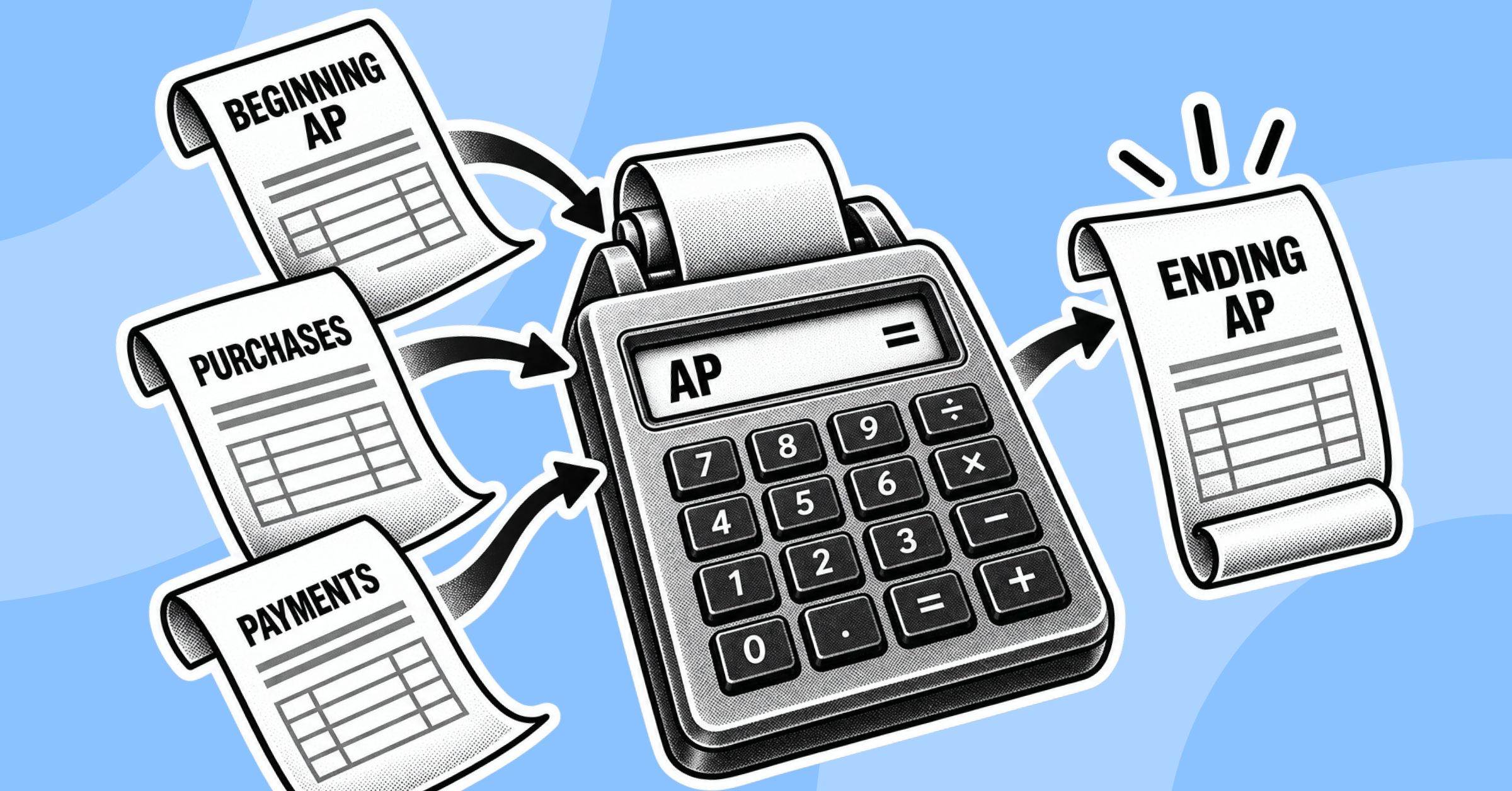
- The formula for the ending AP balance is Beginning AP plus Credit Purchases minus Supplier Payments.
- "Calculate accounts payable" (the balance) and "calculate accounts payable days" (the ratio) are two different questions. This guide covers the balance. If you need the days-based ratio, see our accounts payable days guide instead.
- Once you have your AP balance, it feeds three related ratios: Average Accounts Payable, Accounts Payable Turnover Ratio, and DPO/AP Days.
- The most common mistakes are confusing beginning and ending balances, missing credit purchases, and omitting partial payments.
Accounts payable shows up on the balance sheet as a single line, but getting to that number correctly, and understanding what it actually represents, trips up more people than you'd expect, especially anyone newer to AP or bookkeeping. This guide covers both: what accounts payable is, and exactly how to calculate the balance.
A quick overview: this guide defines accounts payable, gives you the balance formula and a full worked example, and shows how that balance feeds into the ratios (Average AP, AP Turnover Ratio, and AP Days/DPO) covered in more depth elsewhere in this series.
What Is Accounts Payable?
Accounts payable is a liability account representing money a company owes to its suppliers or vendors for goods and services it has already received but not yet paid for. It sits on the balance sheet as a current liability, and it's one of the more actively managed line items in finance, since how quickly (or slowly) a company pays its AP directly affects its cash position.
Accounts Payable Balance vs. Accounts Payable Days: Two Different Questions
Before going further, it's worth pausing on something that trips a lot of searches up. "How do I calculate accounts payable" and "how do I calculate accounts payable days" sound similar but ask two completely different things. This guide answers the first: what is my current AP balance. If what you actually need is the days-based metric that tells you how long it takes to pay suppliers on average, that's a separate calculation covered in our accounts payable days guide.
What Is the Accounts Payable Formula?
The formula for your ending accounts payable balance is:
Ending Accounts Payable = Beginning Accounts Payable + Credit Purchases − Supplier Payments
- Beginning Accounts Payable: the AP balance carried over from the prior period.
- Credit Purchases: the cost of goods or services purchased on credit during the current period.
- Supplier Payments: the total cash paid out to settle vendor bills during the period.
Worked Example: Calculating Accounts Payable Step by Step
- Beginning AP: $12,000
- Credit Purchases: $8,000
- Supplier Payments: $5,000
Ending AP = $12,000 + $8,000 − $5,000 = $15,000
The company's outstanding obligations to vendors increased over the period, since new credit purchases outpaced the payments made against them.
How Accounts Payable Feeds Into Other AP Ratios
Once you have a reliable AP balance, it becomes the input for three related, but distinct, metrics:
- Average Accounts Payable: (Beginning AP + Ending AP) / 2. This smooths out the balance across a period and feeds directly into the two ratios below.
- Accounts Payable Turnover Ratio: Total Credit Purchases / Average Accounts Payable. This measures how many times your AP balance turns over in a period, a frequency, not a day count.
- DPO / AP Days: (Average Accounts Payable / COGS) × 365. This converts your AP balance into an average days-to-pay figure, covered in full detail in our accounts payable days guide, alongside the closely related average payment period calculation.
Getting the underlying AP balance right, using the formula above, is what makes every one of these downstream ratios trustworthy.
Common Mistakes When Calculating Accounts Payable
- Confusing beginning and ending balances. Swapping which balance is "beginning" and which is "ending" flips the sign of the calculation entirely.
- Missing credit purchases. Purchases made late in the period, or through a subsidiary system that doesn't feed the main ledger promptly, are easy to leave out.
- Omitting partial payments. A supplier payment that only partially settles an invoice still needs to be captured in full in the Supplier Payments figure for the period.
How to Keep Your Accounts Payable Balance Accurate Without Manual Reconciliation
The formula above looks simple, but keeping the underlying inputs accurate gets considerably harder once credit purchases and supplier payments are spread across multiple entities, currencies, or ERPs, especially when reconciliation still happens through manual spreadsheet exports. Bluecopa's finance operations platform keeps AP balances current in real time across every entity, automatically capturing credit purchases and supplier payments as they post, so enterprise finance teams always have an accurate, audit-ready AP balance without waiting on a manual close to reconcile it.
Frequently Asked Questions
1. What is the formula for accounts payable?
Ending Accounts Payable equals Beginning Accounts Payable plus Credit Purchases minus Supplier Payments.
2. Is accounts payable the same as accounts payable days?
No. Accounts payable is a balance, the amount currently owed to suppliers. Accounts payable days (also called DPO) is a ratio measuring the average number of days it takes to pay that balance. They answer different questions.
3. What's the difference between accounts payable and accounts payable turnover ratio?
Accounts payable is the balance itself. The turnover ratio (Total Credit Purchases divided by Average Accounts Payable) measures how many times that balance turns over in a period, a frequency rather than a dollar figure.
4. How often should accounts payable be calculated?
Most companies calculate it monthly as part of the standard close, though real-time tracking is increasingly common for companies managing AP across multiple entities.
5. What happens if my accounts payable balance is wrong?
An inaccurate AP balance throws off every downstream ratio built on top of it, including AP Turnover Ratio and AP Days/DPO, and can misstate your company's actual cash position and short-term liabilities.