

Key Takeaways
- Most companies outgrow their ERP's native intercompany module well before they outgrow the ERP itself; the trigger is usually entity count, transaction volume, or a multi-ERP environment, not company size alone.
- ERP intercompany modules typically handle transaction recording but not automated matching, exception workflows, or elimination visibility across entities, which is where manual work piles up.
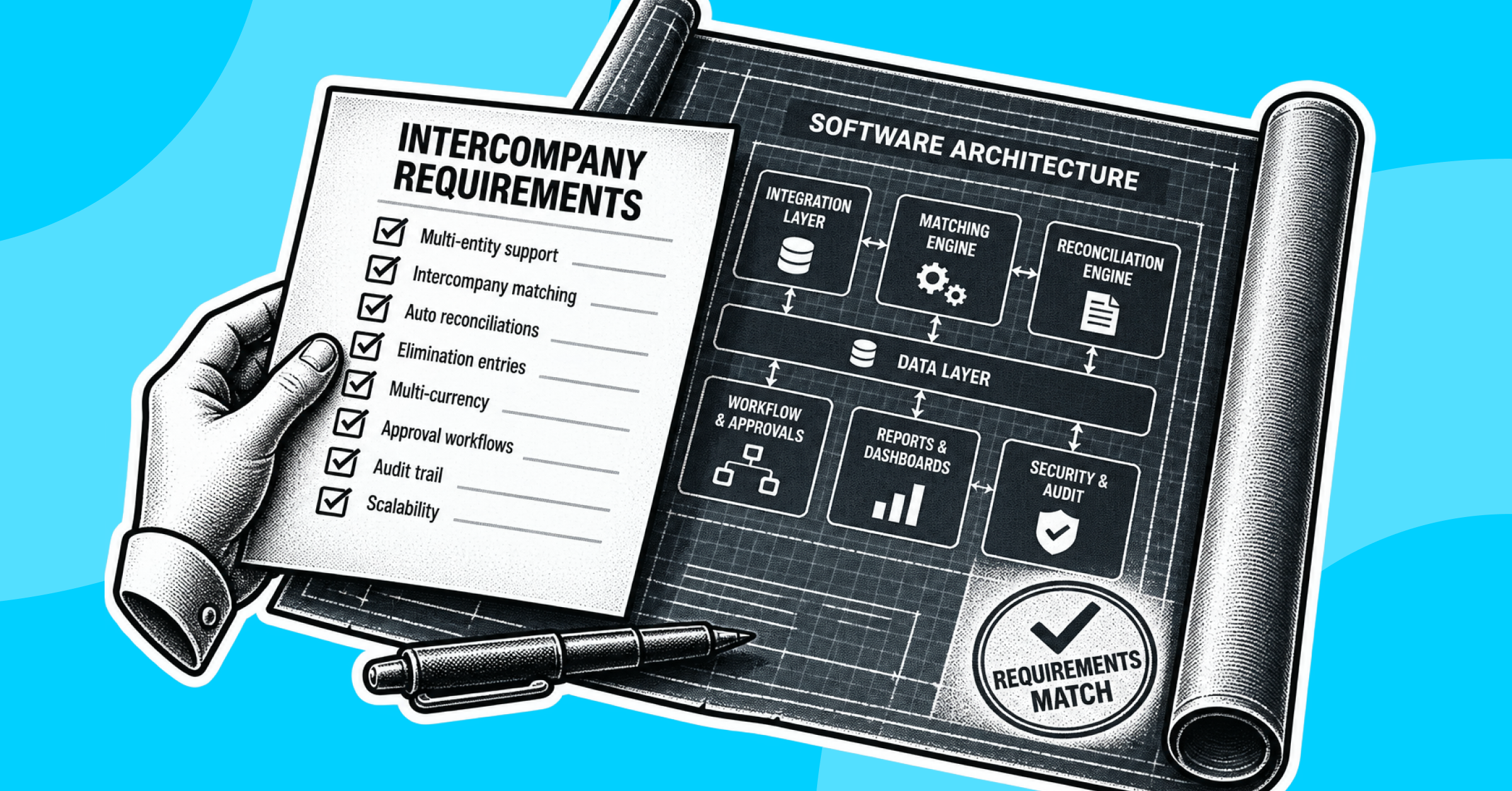
- The evaluation should weigh six areas: automation and reconciliation depth, ERP and multi-entity scalability, visibility and governance, ease of implementation, security and compliance, and pricing transparency.
- Recurring intercompany disputes, unresolved balances at close, and manual spreadsheet elimination work are the clearest signs it's time to evaluate dedicated software.
- Pricing structure matters as much as features. A vendor that won't explain how it scopes cost by entity count, transaction volume, or module is a red flag, not a minor inconvenience.
- Implementation timeline and time-to-value should be evaluated with the same rigor as feature checklists, since a nine-month rollout can erase a year of expected ROI.
Intercompany accounting software sits in an odd spot for a lot of finance teams. It's not the first system you buy, and by the time you're actively searching for "intercompany accounting software," you've usually already lived through the pain: entities that don't reconcile cleanly, a close that keeps slipping because one subsidiary's numbers don't tie out, or a finance team stitching together eliminations in a spreadsheet every month. The question isn't whether intercompany accounting is hard. It's whether your current setup, usually your ERP's native intercompany module, is still the right tool for the complexity you're running today.
This guide walks through how to make that call, and if the answer is yes, exactly what to evaluate before you commit budget to a platform.
A quick overview: you'll find a straightforward self-assessment for whether you need dedicated software at all, a breakdown of where ERP-native intercompany modules typically stop being enough, the specific automation and reconciliation capabilities worth testing, how to evaluate multi-entity and cross-ERP scalability, the governance and visibility features that matter for audit and controls, how to size up implementation timelines honestly, what pricing transparency should actually look like, and the warning signs that tell you it's time to move off manual or ERP-only intercompany accounting.
Do You Need Dedicated Intercompany Accounting Software?
Not every finance team needs a standalone intercompany accounting platform. If you're running a handful of legal entities on a single ERP instance, with low intercompany transaction volume and a close that finishes on time, your existing setup may still be doing its job.
Dedicated software earns its cost when one or more of these is true:
- Entity count is climbing. Acquisitions, new subsidiaries, or new market entities each add a fresh set of intercompany relationships to reconcile and eliminate every period.
- You're running more than one ERP. Different business units on SAP, Oracle, NetSuite, or Dynamics means intercompany balances have to be matched and eliminated across systems that don't talk to each other natively.
- Transaction volume has outgrown manual matching. A few hundred intercompany transactions a month is manageable by hand. A few thousand, across multiple currencies and entities, is not.
- Close timelines keep slipping because of intercompany, specifically. If the bottleneck each period is unresolved intercompany balances or elimination entries, that's a process problem software is built to solve, not a staffing problem.
- Auditors are asking harder questions about intercompany controls. Growing scrutiny on intercompany elimination, transfer pricing support, and balance confirmations is a signal that ad hoc spreadsheet processes won't hold up much longer.
If none of these describe your situation yet, it's reasonable to wait. If two or more do, it's worth running a real evaluation rather than absorbing another year of manual workaround.
Why Your ERP's Native Intercompany Module Isn't Enough at Scale
Every major ERP, SAP, Oracle, NetSuite, Dynamics, Sage Intacct, includes some form of intercompany functionality. That's usually enough to record intercompany transactions and post them to the right entities. It's rarely enough to manage the full intercompany lifecycle at scale.
Here's where the gap typically shows up:
- Matching stops at the transaction level, not the balance level. Most ERP intercompany modules record entries correctly but don't automatically match and reconcile intercompany balances across entities, especially across multiple ERP instances after an acquisition.
- Exception handling is manual. When intercompany balances don't tie out, the ERP flags a mismatch at best. It doesn't route the discrepancy to the right owner, track its resolution, or maintain an audit trail of what changed and why.
- Elimination entries require spreadsheet work. Consolidation and elimination logic often lives outside the ERP entirely, in a spreadsheet someone rebuilds every close cycle, which introduces both error risk and key-person dependency.
- Cross-ERP visibility doesn't exist. If your entities run on different ERPs, which is common after M&A, the native module for any one ERP simply can't see intercompany activity happening in another system.
- Governance and approval trails are thin. Native modules generally aren't built around configurable approval hierarchies, segregation-of-duties controls, or a documented workflow auditors can review directly.
None of this means your ERP is a bad system. It means intercompany accounting, as a process, tends to outgrow what a general ledger module was designed to do. That's the gap dedicated intercompany accounting software is built to close.
Automation and Reconciliation Capabilities to Evaluate
This is the core of the evaluation, and it's where the difference between "digitizes a manual process" and "actually removes the manual work" shows up fastest.
- Automated matching, not just automated recording. Look for multi-field matching logic (entity, amount, currency, transaction reference, date) that can automatically tie out intercompany balances instead of just posting them.
- Exception-based workflow. Only unmatched or mismatched items should require human review. If every intercompany transaction still needs a person to look at it, the software isn't reducing hands-on work, it's just moving it into a new interface.
- Elimination automation. The platform should generate elimination entries directly from matched intercompany activity, not require a separate spreadsheet-based consolidation step after reconciliation is done.
- Currency and intercompany markup handling. For multi-currency intercompany transactions, confirm the software handles FX translation and any intercompany markup or transfer pricing adjustments without manual recalculation.
- Audit trail depth. Every match, exception, and resolution should be logged with who acted, when, and why, not just a final reconciled balance.
Ask any vendor to walk through an actual mismatched intercompany balance in a demo, not a clean, already-matched example. How the exception gets surfaced, routed, and resolved tells you more than a feature list will.
Multi-Entity and Cross-ERP Scalability
Intercompany accounting software is only as useful as its ability to work across every entity and every ERP instance you run, today and after your next acquisition.
- Entity scalability without re-implementation. Adding a new entity or subsidiary should be a configuration step, not a project that requires vendor professional services every time.
- True multi-ERP support. Confirm the platform can ingest and reconcile data from multiple ERP systems simultaneously (SAP, Oracle, NetSuite, Dynamics, Sage Intacct, and others), not just multiple company codes within a single ERP instance.
- Consolidated intercompany view. You should be able to see intercompany balances and elimination status across the entire entity structure in one place, not entity by entity.
- Volume headroom. Ask how the platform performs at transaction volumes significantly higher than your current state. A tool that works at today's volume but slows down or requires a pricier tier at double the volume isn't really scalable, it's a near-term fix.
This is the criterion most likely to get underweighted in an evaluation, because current-state volume and entity count are easy to test and future growth isn't. Push vendors for specifics on how the platform has scaled for other multi-entity, multi-ERP customers, not just a general claim that it "scales."
Visibility, Accountability, and Governance Features
Intercompany accounting carries real audit and controls exposure. Unresolved intercompany balances are a recurring finding in SOX testing and external audits, and a platform that can't demonstrate governance is a platform that creates audit risk instead of reducing it.
- Configurable approval workflows. Elimination entries and intercompany adjustments above a defined threshold should route through approval, not post automatically without review.
- Segregation-of-duties controls. The person who identifies a mismatch and the person who approves its resolution should be able to be different people, enforced by the system, not by policy alone.
- Real-time status visibility. Controllers and intercompany accounting leads should be able to see, at any point in the close, which entities have unresolved balances and which are fully reconciled, without pulling a manual status report.
- Audit-ready documentation. Every reconciliation, exception, and approval should generate documentation an external auditor can review directly in the system, not require the team to reconstruct history from email threads.
Governance features are the ones that tend to get skipped in a feature demo because they're less visually impressive than automated matching. They're also the ones your audit committee will ask about first.
Implementation Timeline and Ease of Adoption
A platform with a strong feature set is still a poor choice if it takes the better part of a year to go live. Implementation timeline deserves the same scrutiny as functionality, and it's a place where vendors are often vague until you press for specifics.
- Ask for a realistic go-live timeline, not a best-case one. Get a range based on your actual entity count and ERP complexity, and ask what has caused past implementations to run longer.
- Confirm what internal resources the rollout requires. Some platforms need significant IT involvement and dedicated administrators; others are largely configured by the finance team itself. Know which one you're buying before signing.
- Check time-to-first-value, not just time-to-full-deployment. A phased rollout that gets your highest-volume entities live and reconciling within weeks, with the rest phased in after, is a meaningfully different commitment than an all-or-nothing go-live.
- Ask about data migration and historical balances. Moving existing intercompany balances and open items into a new system is often the slowest part of implementation. Get specifics on how the vendor handles it.
If a vendor can't give you a concrete implementation timeline grounded in your entity count and ERP mix, treat that as a warning sign about how the rollout will actually go, not as an acceptable "it depends."
Pricing Structure and Transparency
Pricing is a legitimate evaluation criterion, not an afterthought you deal with once you've already picked a finalist. How a vendor prices tells you a lot about how predictable your cost will be as you add entities, volume, or modules.
- How the vendor structures pricing. Confirm whether cost scales by entity count, transaction volume, number of users, or module selection, and get that in writing before you're deep into a sales cycle.
- Whether pricing is published or quote-only. Most intercompany accounting software is quote-based, which is normal for enterprise finance software. What matters is whether the vendor will walk you through the actual cost drivers early, or keeps every number vague until a proposal.
- Hidden costs to ask about directly. Implementation fees, per-entity or per-ERP connector charges, admin or user-seat fees, and costs for adding modules later should all be confirmed up front, not discovered at renewal.
- Cost predictability as you scale. Ask what it costs to add five more entities or double transaction volume next year. A vendor that can answer clearly is giving you a real answer; one that can't is asking you to buy on faith.
Treat vendor evasiveness on pricing mechanics the same way you'd treat evasiveness on data security. If a vendor won't explain how their pricing works before you've signed anything, that's information about how the relationship will go after you have.
Warning Signs It's Time to Upgrade From Manual or ERP-Only Intercompany Accounting
If you're still weighing whether this is worth pursuing right now, these are the operational signals worth taking seriously:
- Intercompany disputes recur every close, involving the same entities. If the same pair of entities has an unresolved balance three closes in a row, that's a process gap, not a one-off error.
- Elimination entries are built in a spreadsheet, by one person. Key-person dependency on intercompany close work is a controls risk, and it doesn't scale past the person who built the spreadsheet.
- Close is delayed specifically because of intercompany reconciliation. If every other part of close finishes on time and intercompany is consistently the long pole, that's a targeted, solvable problem.
- A recent or pending acquisition adds a new ERP to the mix. Cross-ERP intercompany reconciliation by hand gets exponentially harder with each additional system.
- Auditors have flagged intercompany balances or controls as an issue. A documented finding is a clear, unambiguous signal that the current process won't hold up to increasing scrutiny.
- Finance leadership can't get a same-day answer on unresolved intercompany balances. If getting that answer requires pulling multiple people and spreadsheets together, visibility is the gap, and it's exactly what dedicated software is built to close.
None of these signals alone means you need to buy software tomorrow. Two or three of them together, especially if they're recurring rather than one-time, are a strong case for starting a real evaluation.
How Bluecopa Handles Intercompany Accounting for Enterprise Finance Teams
Bluecopa is an AI-native finance operations platform that unifies Order-to-Cash, Procure-to-Pay, and Record-to-Report, including reconciliation, continuous close, journal automation, and intercompany elimination, on a single data layer. For enterprise finance teams evaluating intercompany accounting software, that unification is the core differentiator against point tools that only address one piece of the process.
The reconciliation and matching work described above is handled by Samyx Recon, Bluecopa's matching engine, which processes over 5 million records per hour at 97-99% accuracy using a hybrid of deterministic and multi-field fuzzy matching. It's built specifically for cross-entity and cross-ERP matching, not just reconciliation within a single ledger, which addresses the multi-ERP scalability gap most ERP-native intercompany modules can't close. Samyx Extract handles PDF and spreadsheet-based intercompany documentation with page and line-level provenance, and Samyx Build applies policy-as-code gates for approvals, thresholds, and segregation-of-duties checks, which map directly to the governance and accountability criteria outlined above.
Bluecopa connects to 200+ systems, including SAP, Oracle, NetSuite, Sage Intacct, and Dynamics, which matters directly for the multi-entity, multi-ERP scalability criterion. Enterprise customers using Bluecopa's platform for reconciliation and close have seen measurable results: Yatra achieved 7x faster AR reconciliation and a 90% faster month-end close, and HackerEarth reduced reconciliation errors by 60%.
On pricing, Bluecopa's own model is quote-based and scoped to entity count, transaction volume, and the modules you need, consistent with the pricing-transparency standard this guide asks every vendor to meet. Bluecopa is built for enterprise finance teams; it does not offer treasury management, FP&A planning and budgeting, statutory financial consolidation, or full procurement sourcing, so teams evaluating those specific needs alongside intercompany accounting should weigh that scope directly against their requirements.
Frequently Asked Questions
1. Do I need dedicated intercompany accounting software, or is my ERP enough?
It depends on entity count, transaction volume, and whether you run a single ERP or multiple. A small number of entities on one ERP with low intercompany volume can often manage with native functionality. Growing entity count, multiple ERPs, or recurring close delays tied to intercompany reconciliation are signs it's time to evaluate dedicated software.
2. What's the biggest limitation of an ERP's native intercompany module?
Most ERP intercompany modules record transactions correctly but don't automate matching, exception workflows, or cross-ERP visibility. That leaves reconciliation and elimination work to be done manually, often in spreadsheets, especially once entities span more than one ERP system.
3. How much does intercompany accounting software cost?
Pricing is typically quote-based and scoped to entity count, transaction volume, user count, and the modules selected, rather than published as a flat rate. When evaluating vendors, ask directly how pricing scales with growth and what hidden costs, like implementation or per-entity fees, might apply.
4. How long does implementation usually take?
It varies by entity count and ERP complexity, but this is a question to press vendors on directly rather than accept a vague answer. Ask for a realistic timeline based on your actual environment, what internal resources the rollout requires, and whether a phased go-live is possible so your highest-volume entities see value before the full rollout is complete.
5. What features separate dedicated intercompany software from a generic reconciliation tool?
Look for automated cross-entity and cross-ERP matching, automated elimination entry generation, configurable approval and segregation-of-duties workflows, and audit-ready documentation, not just transaction matching within a single ledger.
6. Is intercompany accounting software only for large, multi-entity enterprises?
It's most valuable for organizations with meaningful entity count, multi-ERP environments, or intercompany transaction volume that's outgrown manual matching. Organizations below that threshold often manage adequately with their ERP's native functionality until growth or acquisition changes the picture.