

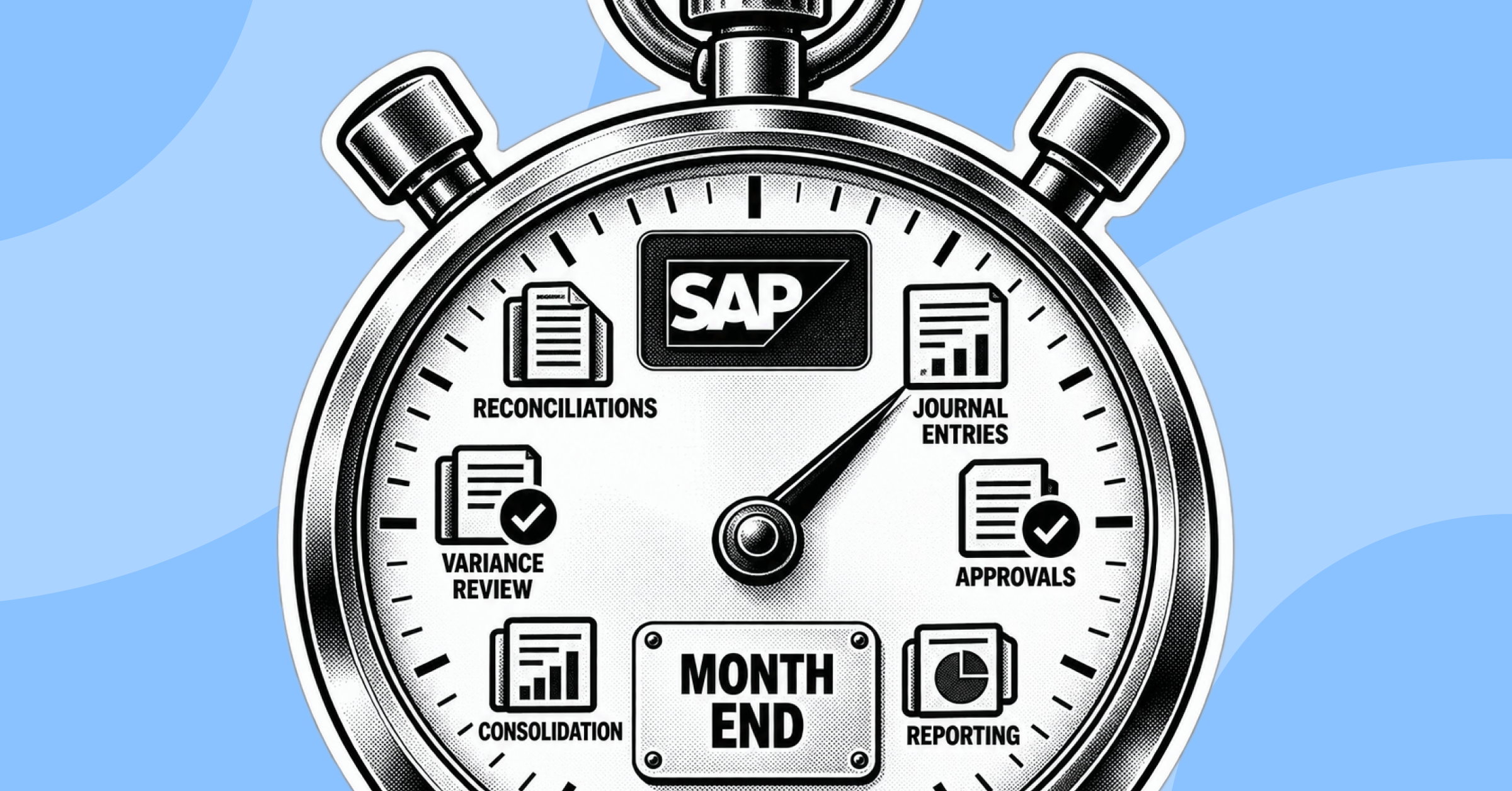
For most enterprise finance teams running SAP, the month-end close is not slow because the ERP lacks features. It is slow because the close process wraps SAP in a layer of manual coordination: spreadsheets tracking task status, emails chasing sign-offs, and reconciliations performed outside the system of record. If you are looking to accelerate close in SAP, the opportunity is rarely "buy more SAP." It is tightening the workflow around SAP so its native strengths (GL posting, sub-ledger integration, real-time data) are not undercut by manual process debt.
This guide covers what actually slows down an SAP close, what SAP's own tools (Financial Closing Cockpit, Advanced Financial Closing) can and cannot solve, and the concrete steps a controller or GCC close lead can take to compress days-to-close without a disruptive re-implementation.
Why Does the SAP Financial Close Take Longer Than It Should?
Most SAP close delays trace back to a handful of recurring root causes, and they tend to compound each other:
- Task tracking lives outside SAP. Close checklists in Excel or shared trackers require manual updates, so status visibility lags reality by hours or days.
- Reconciliation is manual and siloed. GL, bank, and intercompany matching are often done in spreadsheets even when the underlying data sits in SAP FICO.
- Journal entries require manual preparation. Recurring accruals, allocations, and adjustments get re-keyed every period instead of templated or triggered automatically.
- Dependencies are invisible until they break. A late sub-ledger feed or blocked intercompany confirmation is discovered only when it delays the next task.
- Multi-entity complexity multiplies manual work. Enterprises running multiple company codes or plants often close each one with a near-identical but separately maintained task list.
None of these are SAP defects. They are process gaps around SAP, which is exactly why close automation software aimed at the workflow layer, rather than the ERP layer, tends to produce the fastest wins.
What Does "Accelerating Your Close" Actually Mean in an SAP Environment?
Accelerating close in SAP is not a single initiative. It is a combination of five distinct levers, and most SAP shops have only addressed one or two:
- Automating repetitive task execution so recurring close tasks fire on schedule or on event triggers instead of being manually kicked off.
- Standardizing the task list across company codes and plants so every entity closes against the same best-practice checklist instead of a locally maintained variant.
- Automating reconciliation for GL, bank, and intercompany balances so matching happens continuously rather than in a manual crunch at period end.
- Gaining real-time visibility into close progress, so bottlenecks are flagged while there is still time to act.
- Shifting toward continuous accounting, where reconciliation and control checks happen throughout the period instead of being pushed into the close window.
Each lever has a native SAP tool that addresses part of it, and each has a practical ceiling. The sections below cover how to work each lever and where enterprises typically need to extend beyond native tooling.
How to Automate Repetitive Close Tasks in SAP (Step by Step)
The fastest wins usually come from removing manual triggering and tracking for tasks that already follow a predictable pattern. Confirm the exact configuration path in your SAP version and support pack before rolling this out, since navigation varies by release.
Step 1: Inventory recurring tasks and their triggers
- List every task performed each close cycle: accrual postings, allocations, report runs, reconciliation steps, sign-offs.
- For each task, identify whether it is currently triggered manually or by a fixed calendar date, and whether it could instead be triggered by an event (goods receipt posted, invoice received, sub-ledger closed).
Step 2: Move fixed-date tasks to event-driven scheduling
- Where a task genuinely depends on an upstream event rather than a date (for example, an accrual that should only post once all vendor invoices are received), configure it to trigger on that event instead of a static day-of-month rule.
- This avoids the common failure mode where a task runs "on time" per the calendar but before its actual prerequisite data is ready, producing rework.
Step 3: Automate GRNI and accrual workflows
- Goods-receipt/invoice-receipt (GRNI) clearing and period-end accrual calculations are high-frequency, rules-based tasks well suited to automation: define the matching and calculation logic once, then let the system apply it every period.
- Route exceptions (unmatched GRNI lines, accruals outside expected variance thresholds) to a queue with a named owner and a resolution deadline, instead of leaving them for someone to notice in a spreadsheet.
Step 4: Remove spreadsheet and email tracking
- Replace the shared close-tracker spreadsheet and status-update email threads with a single system of record for task status, ownership, and due dates.
- Every task owner updates status in one place, and every stakeholder (controller, GCC lead, audit liaison) reads status from that same place, not a manually compiled summary.
Done well, this step alone often removes a full day or more from the close calendar by eliminating the lag between a task being done and someone reporting it as done.
How Do You Monitor Your SAP Close in Real Time?
Visibility is the difference between catching a bottleneck on day 2 of a five-day close and discovering it on day 5, with no time left to react. Real-time close monitoring rests on three capabilities:
- A close-progress dashboard. A single view showing every task, its status, owner, and due time, similar in spirit to a Financial Close Overview-style dashboard, gives controllers a live read on where the close stands rather than relying on a status meeting or emailed summary.
- Critical-path analysis. Not every late task threatens the close date. Identifying which tasks sit on the critical path (the dependent sequence that determines when the close can finish) lets a controller focus on what actually matters.
- Drill-down by company code, plant, or task. An aggregate "close is 80% complete" figure hides which company code or plant is actually behind. Drill-down views by entity and task type let a GCC or shared-services team pinpoint exactly where intervention is needed.
This is where SAP Advanced Financial Closing (AFC) fits in. AFC is SAP's own tool for orchestrating close tasks, scheduling them, and tracking status and dependencies across a close calendar, building on the Financial Closing Cockpit's task-list concept with more automation and monitoring capability. For organizations running a relatively contained SAP landscape, AFC can provide meaningful visibility gains on its own.
Where AFC tends to hit limits is in environments with complexity outside pure SAP task orchestration: heavy dependence on non-SAP execution systems, reconciliation volumes needing exception-level automation, or a GCC spanning many entities where a consolidated view across systems, not just SAP company codes, is what leadership needs. That gap pushes many enterprise SAP shops toward a workflow and reconciliation layer on top of both AFC and any non-SAP systems.
How to Standardize and Centralize SAP Close Tasks (Step by Step)
Standardization matters most in multi-entity SAP environments, where every additional company code or plant maintaining its own close checklist adds both close time and audit risk, since it's harder to verify every entity is following the same control procedures.
Step 1: Build a best-practice closing task-list template
- Define one master close checklist reflecting best-practice sequencing and control points, and apply it as the baseline for every entity instead of letting each maintain its own variant.
- Include task descriptions, standard owners by role rather than by named individual, expected duration, and dependencies.
Step 2: Mass-create manual tasks via spreadsheet upload
- For tasks that cannot be fully automated (manual reviews, judgment-based adjustments, approvals), use a bulk upload process to instantiate the same task across every relevant company code or plant in one action.
- This keeps manual tasks consistent across entities even though they are not automated end to end.
Step 3: Integrate third-party execution systems into one centralized list
- Many close processes depend on systems beyond SAP: treasury platforms, tax engines, consolidation tools, or point solutions for specific sub-processes.
- Integrate SAP and non-SAP tasks into a single centralized list so a controller gets one true picture of close status, regardless of which system a task actually executes in.
Standardization is one area where a dedicated Record to Report workflow layer earns its keep: it can hold the master template, push tasks into SAP and non-SAP systems alike, and report status back into one place, which native SAP tooling is not designed to do across non-SAP systems.
How to Automate GL and Bank Reconciliation Alongside SAP
GL account reconciliation in SAP is frequently still performed by exporting trial balance and sub-ledger data into spreadsheets, then manually matching balances. This is a high-leverage automation area because the underlying logic (match, tolerance-check, flag exceptions) is highly repeatable.
- Automate the match, not just the extract. Pulling SAP data into a spreadsheet faster does not accelerate close if the matching itself is still manual. Use automated matching logic, rules-based with AI-assisted matching for less structured data, that surfaces only genuine exceptions for review.
- Apply the same approach to bank reconciliation. Bank statement data and SAP cash-related GL balances should reconcile continuously against defined tolerance rules, not in a single manual exercise during the close window.
- Route exceptions with context. A GL or bank reconciliation break should arrive with the underlying transaction detail attached, so the reviewer is not starting an investigation from scratch.
Enterprises that automate reconciliation typically see the biggest time savings not from the matching itself, but from eliminating the multi-day "chase the exception" cycle at period end.
How to Reduce Manual Journal Entries and Adjustments During Close
Manual journal entries are a common close bottleneck and a recurring audit focus area, since every manual entry represents both effort and control risk.
- Template recurring entries. Accruals, allocations, and standard reclass entries that repeat every period should be built as templates with pre-defined logic, not re-derived manually each cycle.
- Trigger entries from underlying data. Where an entry's amount can be calculated directly from SAP or sub-ledger data (a depreciation run, a standard accrual formula), generate it automatically rather than having someone calculate and key it in.
- Enforce approval workflow on exceptions. Non-standard or judgment-based entries should route through a defined approval workflow with visible status, not an email chain.
The objective is not zero manual entries, but reserving manual effort for entries that genuinely require judgment while everything rules-based is templated or automated.
How to Manage Intercompany Reconciliation Faster in SAP
Intercompany reconciliation is consistently one of the slowest parts of a multi-entity SAP close, because it requires matching transactions across company codes that post on different timelines or with different reference data.
- Match at the transaction level, not just balance level. Balance-level matching can hide offsetting errors; matching individual postings between entities surfaces the actual source of a mismatch faster.
- Set a cutoff and enforce it. Postings after an agreed cutoff time create chasing and rework. A defined, enforced cutoff with automated flagging of late postings prevents the last-minute scramble.
- Automate the confirmation workflow. Intercompany balance confirmation between entities is often handled by email. A structured workflow with visible status by entity pair reduces the coordination overhead considerably.
Because intercompany reconciliation depends on coordination across entities, and sometimes across ERPs, it benefits disproportionately from a workflow layer that can see both sides of every intercompany relationship at once.
How to Build a Continuous Close Process on Top of SAP
Continuous close means shifting reconciliation, matching, and control checks so they happen throughout the period, leaving the formal close window for review, adjustment, and reporting rather than for the bulk of the reconciliation work itself.
- Reconcile daily or weekly, not just at period end. GL, bank, and intercompany reconciliation on a rolling basis means far fewer open items when the close window opens.
- Monitor control checks continuously. Threshold-based checks (unusual variances, unmatched items above a defined value) should run as transactions post, not as a batch review at close.
- Keep the close checklist "always on." Maintain it as a continuously updated view so status is visible year-round, and the close window becomes a shorter final push rather than the entire effort.
This is a process shift, not a one-time project, and it generally requires a layer above SAP that operates continuously across the period, since SAP's own close tools are oriented around the close window itself rather than year-round monitoring.
Where Do Native SAP Tools Hit Their Limits?
SAP FICO, the Financial Closing Cockpit, and Advanced Financial Closing are genuinely strong at what they are built for: task scheduling, dependency tracking, and status visibility within the SAP landscape. Their practical limits tend to show up in a few consistent places:
- Cross-system visibility. Native SAP tools track SAP tasks well, but a close process depending on treasury systems, tax engines, or other non-SAP applications does not get a unified view without additional integration work.
- Exception-level reconciliation automation. Task orchestration is not the same as automated GL, bank, and intercompany matching at the transaction level, which still often happens outside the SAP task framework in spreadsheets.
- AI-assisted matching for high-volume data. Rules-based matching handles clean, structured cases well, but messier data (varied reference formats, partial matches, multi-currency activity) benefits from AI-driven matching that native SAP tools were not built to provide.
- GCC-specific consolidated reporting. GCCs managing close across many entities, sometimes across multiple ERPs, need a consolidated view a single SAP instance's tooling was not designed to provide.
None of this is a criticism of SAP. It reflects a reasonable scope boundary: SAP is the system of record, and enterprises increasingly pair it with a dedicated workflow and reconciliation layer for the parts of the close that sit above or across the ERP.
How Do You Measure Close Acceleration? KPIs to Track
Close acceleration should be measured, not assumed. A small set of KPIs, tracked consistently, tells you whether the changes above are actually working:
- Days to close. Calendar days from period end to books closed and reported. Track it by entity as well as in aggregate, since a strong average can hide a persistently slow entity.
- Reconciliation exception rate. The percentage of GL, bank, or intercompany accounts requiring manual investigation each period. A falling rate shows automation is reducing exceptions, not just moving them elsewhere.
- Manual journal entry volume. The count and value of manually keyed entries per period. A flat or rising trend signals missed automation opportunities.
- Percentage of tasks completed on schedule. The share of close tasks finished by their target time, surfacing whether bottlenecks are improving or shifting elsewhere.
- Time to resolve exceptions. The average time between an exception being flagged and resolved, a direct measure of whether exception-handling workflow is working.
Set a baseline before making changes, then track these KPIs monthly. Days-to-close tends to improve gradually as the underlying KPIs improve first, so leading indicators matter most in early cycles.
How Bluecopa Complements SAP to Accelerate Close
Bluecopa is an AI-native finance operations platform that sits alongside SAP as an automation and workflow layer, not a replacement for it. For enterprise SAP shops and GCCs where the Financial Closing Cockpit, AFC, and manual reconciliation processes have hit their practical limits, Bluecopa adds AI-driven GL and intercompany reconciliation, structured exception handling, and continuous close visibility across both SAP and non-SAP systems in one place.
SAP remains the system of record and transactional engine, while Bluecopa focuses on the workflow, reconciliation, and monitoring layer that native SAP tooling was not built to fully cover, particularly for organizations managing close across many company codes or a GCC structure. Teams evaluating this kind of layer typically look at it in the context of broader Continuous Close Software options rather than as a standalone point solution.
FAQ
1. What is the fastest way to reduce close time in SAP?
The fastest initial gains typically come from removing manual task tracking and automating GL reconciliation, since both remove multi-day coordination delays without requiring changes to SAP's core configuration.
2. Does SAP Advanced Financial Closing (AFC) fully automate the close?
No. AFC automates task scheduling, dependency tracking, and status monitoring within the SAP task-list framework, but it does not automate reconciliation matching itself, nor does it natively cover non-SAP systems in the close process.
3. How is SAP Financial Closing Cockpit different from SAP Advanced Financial Closing?
The Financial Closing Cockpit is SAP's foundational task-list and scheduling tool for close activities. Advanced Financial Closing builds on that concept with more automation and monitoring capability. Confirm exact feature availability for your release, since this varies by version and licensing.
4. Can you accelerate SAP close without a full S/4HANA migration?
Yes. Most of the acceleration levers covered here, task automation, reconciliation automation, standardized checklists, and real-time monitoring, can be implemented as a workflow layer around an existing SAP environment regardless of when a broader S/4HANA migration happens.
5. What KPIs best show whether SAP close acceleration efforts are working?
Days-to-close is the headline metric, but reconciliation exception rate, manual journal entry volume, and time to resolve exceptions tend to move first and are more actionable leading indicators.
6. Is intercompany reconciliation harder to automate than GL reconciliation in SAP?
Generally yes, because it depends on coordination and matching across separate company codes, and sometimes separate ERPs, whereas GL reconciliation is typically self-contained within one entity's data. Intercompany automation usually delivers a larger relative time saving because the manual overhead it removes is larger to begin with.