



CFOs are investing millions in AI-powered forecasting, real-time analytics, and intelligent automation. Yet in boardrooms across industries, a troubling question persists: "Can we trust these numbers?"
The problem isn't the technology. It's the data underneath it.
Without clean, connected, and governed financial data, even the most sophisticated AI tools produce unreliable outputs, flawed forecasts, and decisions based on partial truths. This is the paradox facing autonomous CFOs: leaders equipped with cutting-edge technology but operating on fragmented, inconsistent data that undermines confidence at every turn.
Gartner's 2025 survey reveals that over 75% of CFOs now own enterprise-wide data and analytics. Financial data management is no longer a back-office function; it's the operating system that powers autonomous finance. Stronger data enables better decisions through:
- Unified visibility: Eliminating blind spots across systems
- Real-time accuracy: Replacing lagging reports with live insights
- Predictive intelligence: Feeding AI models reliable data to forecast trends and detect anomalies
- Confident governance: Building trust through standardized validation and audit trails
Strong financial data management is what separates AI risk from AI advantage. The path forward is to eliminate the data gap and establish the foundation for autonomous operations.
The Data Gap: Why Good Intentions Aren't Enough
While 35% of finance leaders actively deliver data analytics to cut costs and boost effectiveness (per EY's DNA of the CFO survey), many organizations remain stuck on fragmented, inconsistent data. As Deloitte aptly notes, data gets acknowledged as "vitally important" yet routinely deprioritized when other mandates compete for attention.
The autonomous CFO rejects this trade-off, recognizing that data isn't one priority among many; it's the foundation that enables every other objective: cost management, growth, compliance, and risk mitigation. Hence, they seek to address the data gap by laying the groundwork. Here are the key essentials for a strong data foundation.
Building the Data Foundation for Autonomy
- The Unified Finance Data Lake
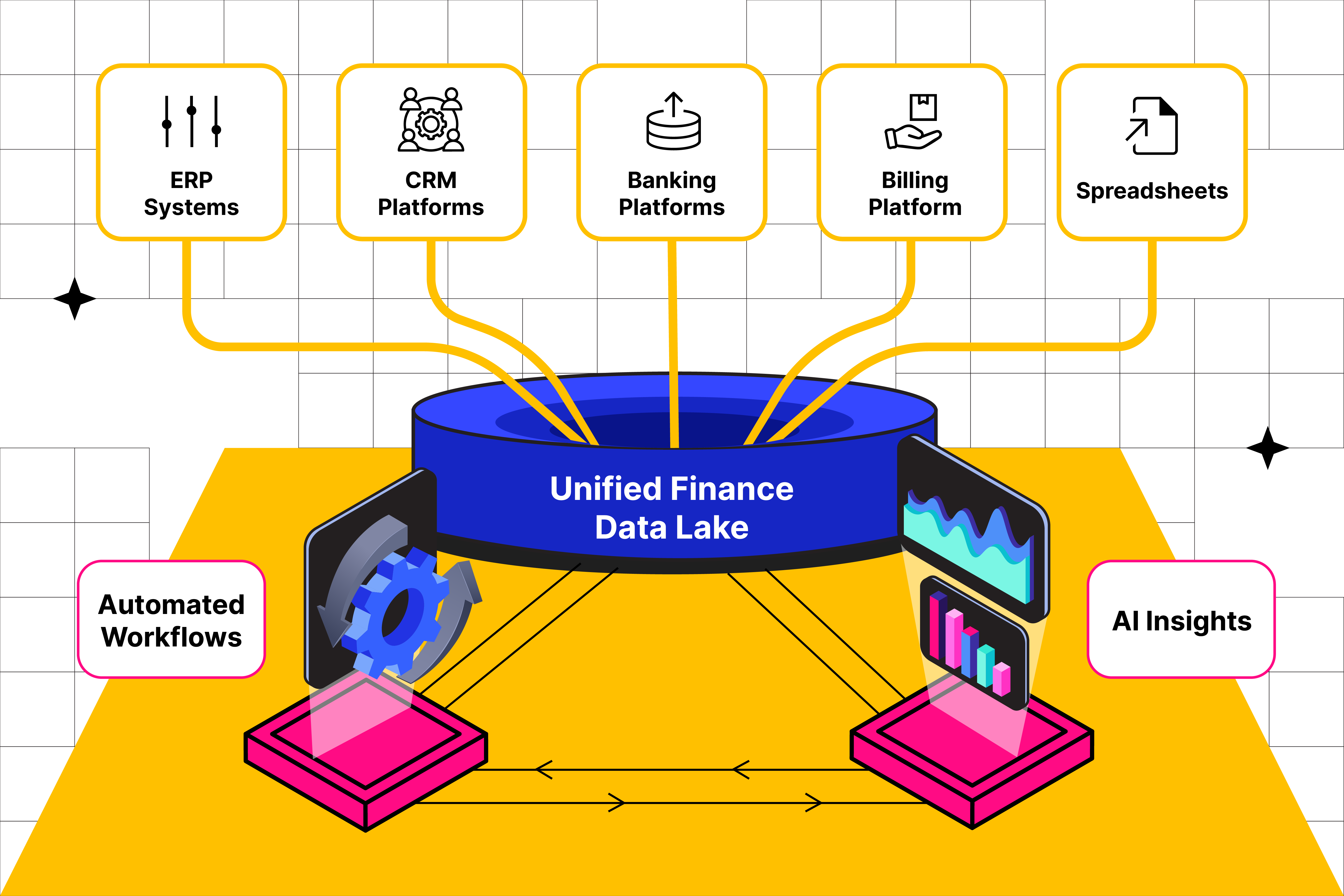
Financial data trapped across disconnected systems creates blind spots, delays, and risk. As Aneal Vallurupalli, CFO of Drata (ex-Airbase), emphasized on The Role Forward Podcast, “without integrated data, insights get 'lost in translation,' slowing decisions and weakening governance.”
The solution is a unified finance data lake, a centralized, purpose-built layer that:
- Continuously ingests and reconciles data in near real-time
- Eliminates manual processes
- Creates a single source of truth
- Enables automated, AI-driven workflows.
For high-growth enterprises, this translates directly to faster closes, improved cash visibility, and tighter working capital control.
- Activating Data Through Automation and AI
A strong data foundation only creates impact when activated at scale. Manual processes can't match the volume, velocity, and complexity of modern finance. We've seen this first-hand with customers in high-transaction-volume businesses like e-commerce:
- Close cycles reduced to under 2 days: Automation replaced spreadsheet reconciliations across banks, gateways, marketplaces, and ERPs, cutting timelines by 80%
- Real-time variance detection: AI continuously analyzes transactions to identify anomalies early
- Predictive liquidity management: AI-driven forecasting supports faster root-cause analysis and stronger cash flow planning
Finance functions leveraging advanced analytics and automation achieve considerable productivity improvements while improving decision quality.
- Data Governance: Scaling with Control
Automation without governance amplifies risk. When data governance breaks down, CFOs face:
- Higher audit and compliance risk from incomplete trails and inconsistent definitions
- Erosion of confidence when reports require manual validation before use
- Slower closes as teams revert to manual checks
- AI models produce unreliable forecasts and flawed scenario planning when fed ungoverned data
As Vallurupalli notes, “governance must evolve alongside technology”. Without clear ownership and standardized controls, AI magnifies data issues rather than surfacing insights.
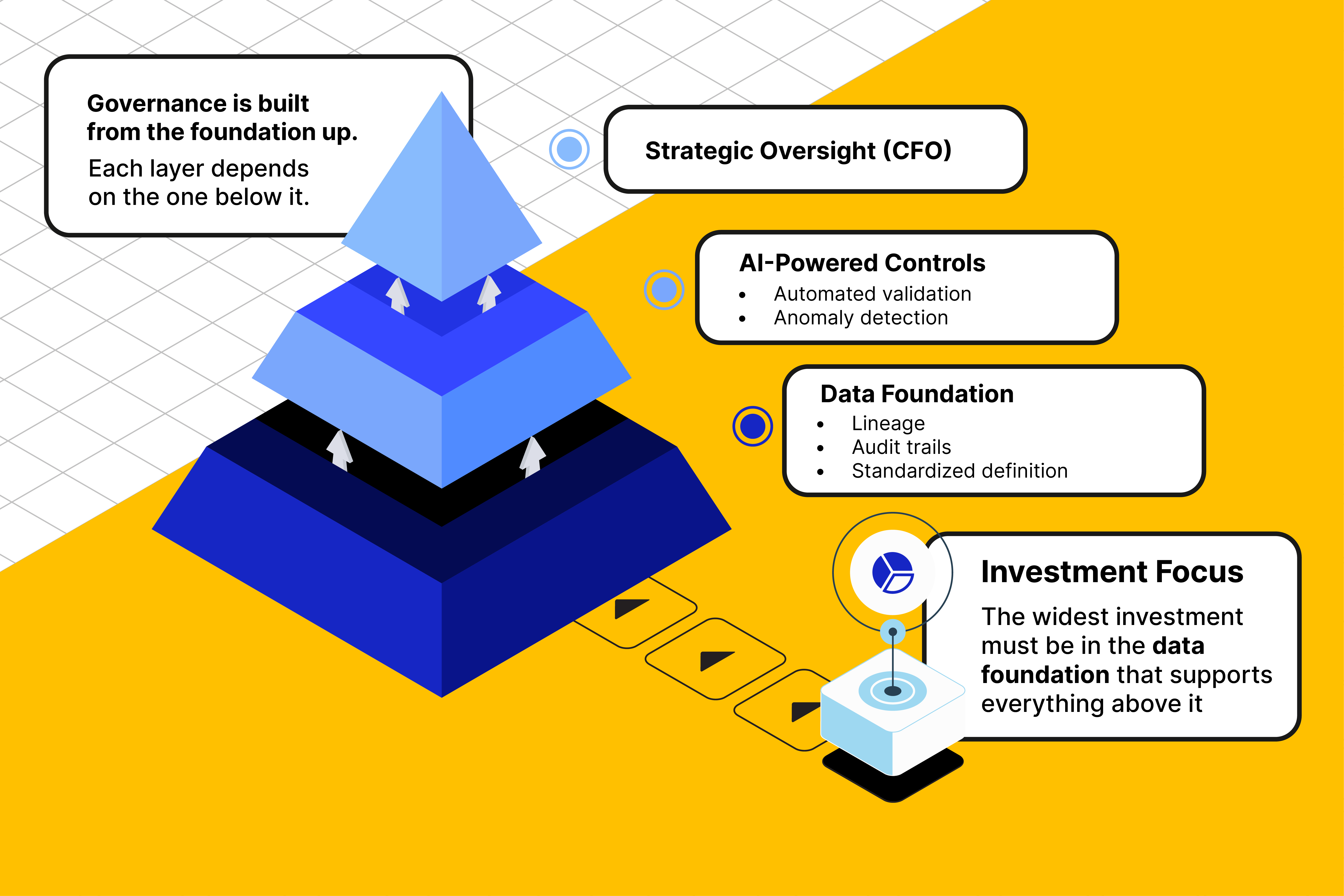
Effective governance frameworks enable CFOs to scale with control through:
- Clear data ownership and accountability
- Standardized validation and reconciliation rules
- Role-based access controls and approvals
- End-to-end data lineage and audit trails
The mandate isn't to slow innovation but to guide it responsibly through phased rollouts, consistent policies, and continuous monitoring.
- Measuring Data Management Impact
The autonomous CFO tracks success through real-time KPIs, not backward-looking reports. Integrated, live dashboards provide up-to-date metrics on demand, eliminating the confidence gap caused by stale data and enabling decisions that drive business outcomes.
- The CFO-CTO Partnership: Building Data Infrastructure
Modern finance transformation requires the CFO-CTO collaboration to build resilient, cloud-based financial data infrastructures. When finance and technology align, organizations accelerate innovation, reduce implementation risk, and improve ROI on technology investments.
Joint roadmaps and shared success metrics ensure finance data initiatives support enterprise priorities.
The Data Management Imperative
Autonomous CFOs who prioritize financial data management will unlock the full potential of AI and automation. Strong data foundations enable CFOs to orchestrate intelligent systems that predict, analyze, and act at scale.
The question isn't whether to invest in financial data management. It's how fast you can make it your foundation.
Bluecopa empowers autonomous CFOs to run financial operations with clean, connected, controlled, and governed data. Our unified finance data platform eliminates fragmentation, accelerates automation, and builds the intelligent foundation AI tools need to deliver real value.
Book a demo with us to see how this works in action for your industry.