

Key Takeaways
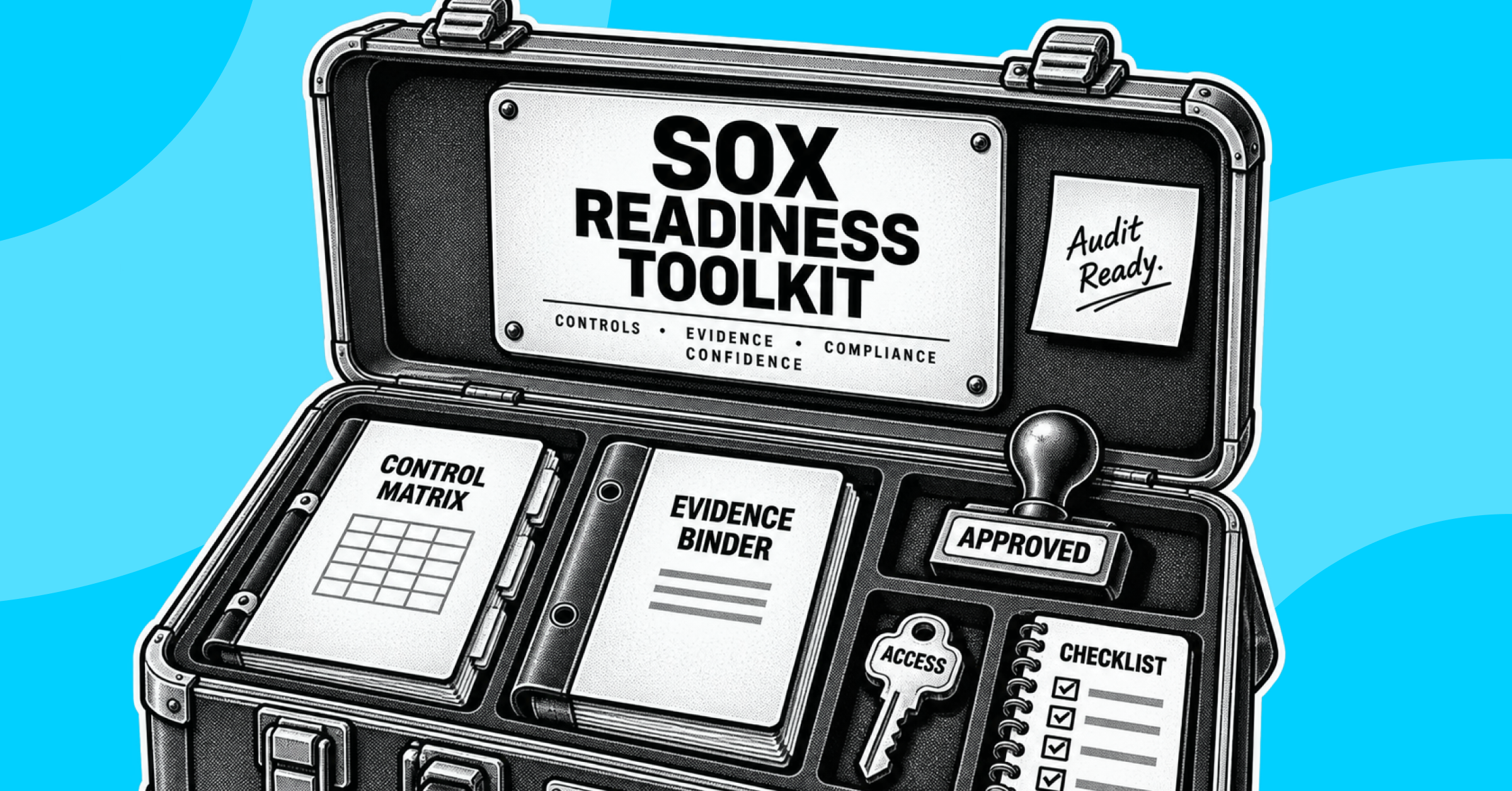
- SOX audit preparation follows a testable four-phase sequence: scoping and risk assessment, documentation and control mapping, IT and access controls, and internal testing and remediation. Skipping a phase to save time is the most common reason companies walk into an audit with unresolved gaps.
- Under PCAOB AS 1305, a control deficiency, a significant deficiency, and a material weakness are three distinct, precisely defined severity levels, not interchangeable terms. Knowing which one applies to a given gap changes how it has to be disclosed.
- Documentation is the deliverable auditors actually test against. A control that exists in practice but isn’t documented in a current process narrative or risk-control matrix is functionally invisible to an auditor.
- IT general controls, access reviews, and change management are tested as rigorously as financial process controls, and they’re the category most often under-scoped by finance teams focused primarily on account-level controls.
- Testing has to happen twice: once internally, before the external auditor arrives, and again as re-testing after remediation. A control that was fixed but never re-tested with evidence isn’t considered remediated.
A SOX audit evaluates whether a company’s internal controls over financial reporting (ICFR) are designed and operating effectively enough to prevent or catch a material misstatement in its financial statements. It’s required under Section 404 of the Sarbanes-Oxley Act of 2002 for public companies, and it’s tested annually by an external auditor as part of the broader financial statement audit. Preparing for one isn’t a single checklist item; it’s a structured, evidence-generating process that has to run months before the auditor’s fieldwork actually begins.
A quick overview: what a SOX audit evaluates and who it applies to, the four-phase preparation sequence (scoping, documentation, IT controls, testing and remediation), the precise difference between a material weakness and a significant deficiency, what the audit process looks like from the auditor’s side, and how automation supports audit readiness.
What a SOX Audit Actually Evaluates
Section 404 of the Sarbanes-Oxley Act requires public companies to include a management assessment of ICFR in their annual report, and, for accelerated and large accelerated filers, requires the external auditor to independently attest to that assessment as part of Section 404(b). The audit isn’t just checking whether the financial statements are correct; it’s checking whether the controls that produce those statements are designed properly and actually operating the way they’re supposed to, consistently, over the period being tested. That distinction, between a control existing on paper and a control operating effectively in practice, is what most of SOX audit preparation is actually about.
Phase 1: SOX Audit Scoping and Risk Assessment
Scoping determines what gets tested, and getting it wrong in either direction creates real cost: too broad, and the team spends months testing controls that don’t matter; too narrow, and a material account or process gets missed entirely.
- Use a top-down, risk-based approach. Start from the financial statements and work backward to identify which accounts and disclosures are material, rather than starting from a list of existing controls and working forward.
- Map where a material misstatement could actually enter the financial statements. This means identifying the specific processes (revenue recognition, intercompany eliminations, journal entry approval) where an error or fraud risk genuinely exists, not every process that happens to touch the general ledger.
- Set explicit materiality thresholds, quantitative and qualitative, before scoping controls. A documented, approved materiality threshold is what everything downstream, including which deficiencies later get classified as significant versus material, gets measured against.
Phase 2: SOX Documentation and Control Mapping
A control that isn’t documented is, from an auditor’s perspective, a control that doesn’t exist. This phase produces the evidence base the rest of the audit runs on.
- Update process narratives for every in-scope financial workflow. A narrative should describe the end-to-end process clearly enough that someone unfamiliar with the team could understand how a transaction flows from initiation to the general ledger.
- Maintain a current risk-control matrix (RCM) that ties each identified risk to the specific control designed to address it, including control frequency, control owner, and the type of evidence that demonstrates it operated.
- Assign clear control ownership. Every control needs a named owner accountable for its operation and its evidence, not a team or department listed generically; auditors will ask who performed the control, not just whether it exists.
Phase 3: IT General Controls and Access Reviews for SOX
IT general controls (ITGCs) get tested with the same rigor as financial process controls, and they’re the category most often under-scoped because finance teams tend to focus preparation effort on account-level controls first.
- Enforce role-based access and least privilege across the ERPs and financial systems in scope, so users only have the system access their role actually requires.
- Validate change-management protocols for any system that touches financial reporting, meaning that changes to ERP configuration, financial reporting tools, or integrations are documented, approved, and tested before deployment.
- Maintain secure, verifiable data backups, both on-site and off-site, since data integrity and availability are part of what ITGCs are testing, not just access control.
- Review user access periodically, not just at go-live. Access that was appropriate when someone joined a role often becomes excessive after an internal transfer or promotion if it isn’t actively reviewed and de-provisioned.
Phase 4: Internal Control Testing and Remediation Before the SOX Audit
This is the phase where a company finds out, before the external auditor does, whether its controls actually work.
- Test both design and operating effectiveness. Design effectiveness asks whether the control, if performed as intended, would actually prevent or detect a misstatement. Operating effectiveness asks whether it was actually performed that way, consistently, throughout the period.
- Remediate and document any deficiency found, including the root cause, not just the symptom. A control that failed because of a system limitation needs a different fix than one that failed because it wasn’t consistently performed.
- Re-test after remediation, with evidence. A fix that hasn’t been re-tested isn’t considered remediated for audit purposes; the re-test, and the evidence generated by it, is what actually closes the gap before the external auditor’s fieldwork begins.
Material Weakness vs. Significant Deficiency: What Auditors Actually Look For
These terms get used loosely in a lot of SOX content, but PCAOB Auditing Standard 1305 defines all three severity levels precisely, and the classification determines what has to be disclosed.
- Control deficiency: occurs when the design or operation of a control doesn’t allow management or employees, in the normal course of their duties, to prevent or detect a misstatement on a timely basis. This includes both a design deficiency (a necessary control is missing or improperly designed) and an operation deficiency (a properly designed control fails to function as intended, or the person performing it lacks the authority or qualification to do so).
- Significant deficiency: a deficiency, or combination of deficiencies, that is less severe than a material weakness but still important enough to merit the attention of those responsible for financial reporting oversight, typically the audit committee.
- Material weakness: a deficiency, or combination of deficiencies, such that there is a reasonable possibility that a material misstatement of the annual or interim financial statements won’t be prevented or detected on a timely basis. Under the standard, “reasonable possibility” means the likelihood is either reasonably possible or probable.
The practical distinction that matters during prep: a significant deficiency gets reported internally to the audit committee. A material weakness has to be disclosed publicly, and it’s the outcome every phase above is designed to prevent from surfacing for the first time during the external audit rather than during internal testing.
What the SOX Audit Process Looks Like From the Auditor’s Side
Preparation goes faster when it’s built around what the auditor is actually going to do, not just what the company has to produce.
- Auditors typically start with a walkthrough of each in-scope process, tracing a transaction from initiation through to the financial statements to confirm the documented control actually matches how the process runs in practice.
- They sample transactions to test operating effectiveness, meaning documentation has to exist for the specific instances they select, not just a general description of how the control usually works.
- They independently assess whether management’s own testing was sufficient, so internal testing needs to be rigorous and well-documented enough to stand on its own, not treated as a formality ahead of the “real” test.
How Automation Supports SOX Audit Readiness
The phases above are achievable manually, but the evidence burden, current documentation, consistent control execution, a defensible audit trail across every in-scope process, is exactly what spreadsheet-based, manually tracked control environments struggle to sustain across an entire fiscal year without gaps.
- Samyx Build enforces segregation of duties and materiality thresholds as policy-as-code directly in the transaction workflow, so the control is applied consistently by design rather than depending on manual adherence that has to be verified after the fact.
- Samyx Recon generates a timestamped, attributable audit trail for every match, override, and approval automatically, which is the specific kind of evidence auditors sample against during testing.
- Because reconciliation, close, and reporting controls run on one platform rather than fragmented spreadsheets and point tools, control ownership and evidence stay centralized instead of scattered across whoever happened to run a process that quarter.
Finance teams building out their broader control environment ahead of a SOX audit may also find it useful to look at Bluecopa’s continuous close platform for how control automation extends beyond reconciliation into the full record-to-report process.
Frequently Asked Questions
1. What is a SOX audit and who is required to have one?
A SOX audit evaluates whether a public company’s internal controls over financial reporting are designed and operating effectively, as required under Section 404 of the Sarbanes-Oxley Act. Accelerated and large accelerated filers require independent external auditor attestation under Section 404(b); non-accelerated filers still perform management’s own assessment under Section 404(a).
2. What’s the difference between a material weakness and a significant deficiency?
Per PCAOB AS 1305, a significant deficiency is a control gap serious enough to merit attention from financial reporting oversight but not severe enough to create a reasonable possibility of a material misstatement. A material weakness meets that higher bar and must be publicly disclosed.
3. How long does SOX audit preparation typically take?
Most companies run the four-phase preparation cycle, scoping, documentation, IT controls, testing and remediation, across two to three quarters ahead of year-end, since remediation identified late in testing needs time to be fixed and re-tested with evidence before the external auditor’s fieldwork.
4. What are IT general controls (ITGCs) and why do they matter for SOX?
ITGCs cover access management, change management, and data backup/recovery for systems that support financial reporting. They’re tested with the same rigor as account-level controls and are commonly under-scoped by teams that focus preparation effort primarily on financial process controls.
5. What happens if a material weakness is found during SOX audit preparation?
It gets documented, remediated, and re-tested with evidence before the audit, wherever possible. If it’s still open at the reporting date, it must be disclosed publicly in the company’s periodic filings, which is why finding it during internal testing rather than during the external audit matters.
6. Does automation eliminate the need for manual SOX controls testing?
No. Automation strengthens the consistency of control execution and the quality of audit-trail evidence, but management is still required to assess and test control effectiveness; automation makes that assessment easier to perform and easier to evidence, not unnecessary.