

Key Takeaways
- Accounts receivable reconciliation compares the AR subledger to the general ledger control account and resolves any variance before the books close.
- The core AR reconciliation process has five repeatable steps: gather records, compare balances, investigate discrepancies, post adjustments, and get review and sign-off.
- Unapplied cash, timing differences, and duplicate or missing invoices cause most AR reconciliation discrepancies.
- Enterprise finance teams reconciling AR across multiple entities or customers cannot rely on manual matching without significant risk of close delays and error.
- Automating AR subledger reconciliation with AI-assisted matching cuts reconciliation time from days to hours while preserving human review of exceptions.
Accounts receivable reconciliation is one of the most frequently performed, and most frequently rushed, control activities in the close cycle. Done well, it catches billing errors, misapplied cash, and revenue leakage before they compound. Done poorly, or skipped under deadline pressure, it lets discrepancies accumulate quietly until they surface as a bad debt write-off or an audit finding. This guide walks through the accounts receivable reconciliation process step by step, with a worked enterprise-scale example, so you can run it consistently every period.
What Is Accounts Receivable Reconciliation?
Accounts receivable reconciliation is the process of verifying that the total balance in the AR subledger, the detailed record of every customer invoice, payment, credit memo, and adjustment, matches the AR control account balance in the general ledger. The subledger and the GL are supposed to move in lockstep: every transaction posted to a customer account should also hit the GL control account. In practice, timing differences, manual journal entries, system integration gaps, and human error cause the two to drift apart. AR reconciliation is the control that catches that drift before financial statements are finalized.
This is distinct from bank reconciliation, which matches cash transactions against a bank statement, though the two processes share the same underlying logic of comparing two independent records of the same activity. If your team also owns cash reconciliation, the mechanics in how to automate bank reconciliation follow a similar structure.
Why Accounts Receivable Reconciliation Matters
AR is typically one of the largest asset balances on the balance sheet, and it is also one of the most manually touched. Every invoice, credit, write-off, and cash application is a point where the subledger and GL can diverge. Left unreconciled, small discrepancies compound across hundreds or thousands of customer accounts and become difficult to isolate months later.
Unreconciled AR has direct downstream consequences. It distorts days sales outstanding (DSO) and cash forecasting, since collections teams are working from balances that may not reflect reality. It creates audit risk, because auditors test AR as a high-value, high-transaction-volume account and will flag unreconciled variances as a control deficiency. It also slows collections directly: if a customer's true open balance is unclear, collectors either chase invoices that were already paid or miss ones that were not, both of which damage customer relationships and delay cash. Teams under pressure to shrink DSO should treat reconciliation accuracy as a prerequisite, not a side task; see DSO reduction software for how the two connect operationally.
How to Reconcile Accounts Receivable (Step-by-Step Process)
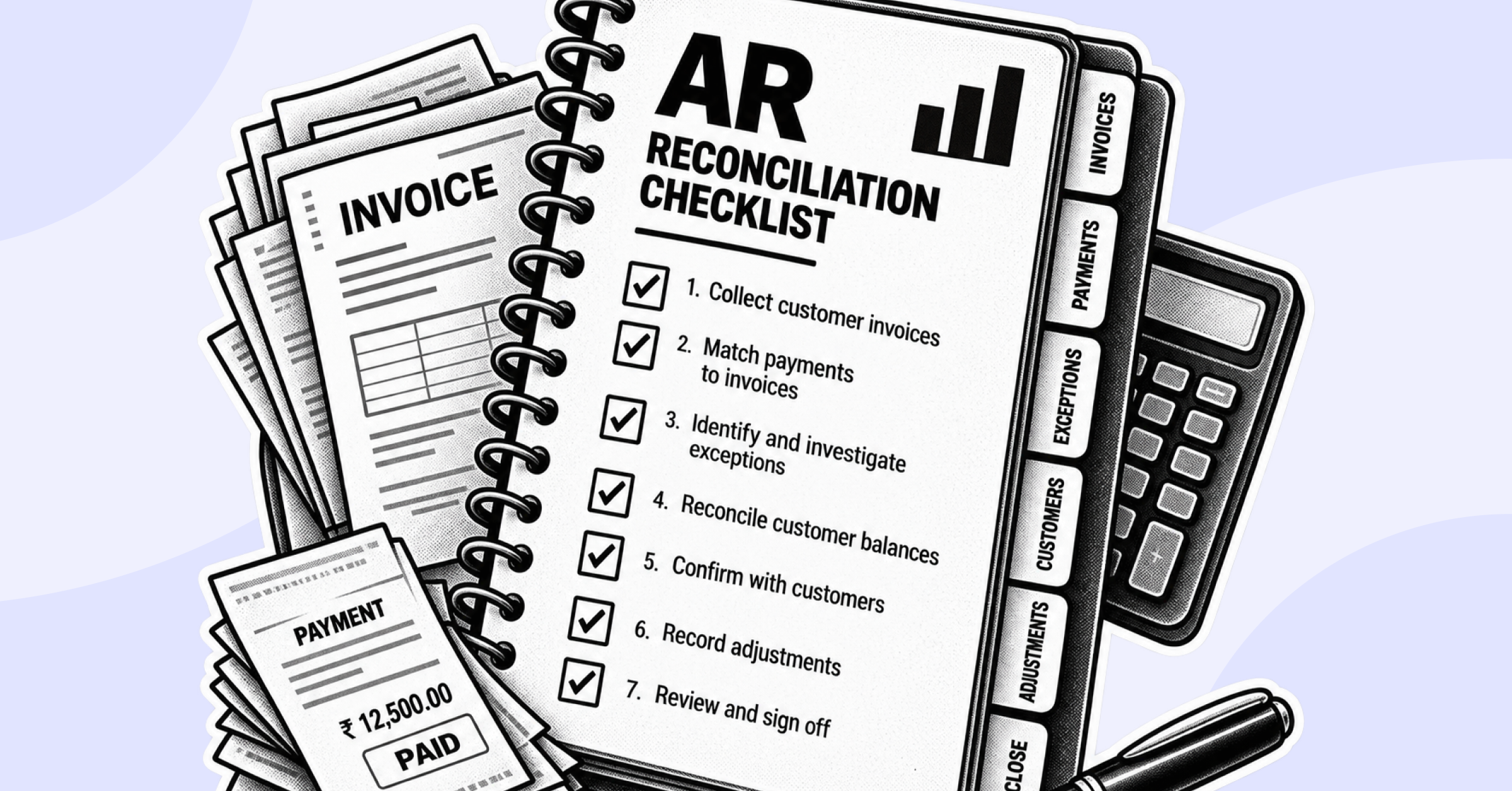
The accounts receivable reconciliation process breaks down into five repeatable steps. Run them in order every period, whether monthly or more frequently.
Step 1: Gather AR Subledger, GL, and Supporting Documents
Pull the AR subledger detail (customer-level invoice, payment, and credit memo activity) as of the reconciliation date, along with the corresponding GL control account balance for the same period. Also gather supporting documents: the aging report, cash application logs, credit memo approvals, and any manual journal entries posted directly to the AR control account during the period. Manual entries to a control account are a common source of subledger-to-GL breaks, so flag them for review at this stage rather than discovering them later.
Step 2: Compare AR Subledger Balance to the GL Control Account
Sum the subledger detail to a single total and compare it against the GL control account balance for the same date. If the two agree, document the tie-out and move to review. If they do not agree, the variance amount becomes the starting point for investigation. This comparison is the heart of accounts receivable subledger reconciliation, and it should be performed at the total level first, then drilled into customer or transaction level only once a variance is confirmed.
Step 3: Investigate and Categorize Discrepancies
Break the variance down into categories: timing differences (a transaction posted to one ledger but not yet the other), unapplied or misapplied cash, duplicate invoices, missing credit memos, currency translation differences for multi-entity books, or a manual journal entry that bypassed the subledger. Categorizing discrepancies before resolving them prevents the common mistake of writing off a variance as "immaterial" when it is actually several offsetting errors that net to a small number.
Step 4: Resolve Discrepancies and Record Adjusting Entries
For each categorized discrepancy, determine the correct treatment: reclassify a misapplied cash receipt to the right customer account, post a missing invoice or credit memo, correct a duplicate entry, or book an adjusting journal entry to true up the GL. Every adjustment should reference the discrepancy it resolves and be traceable back to supporting documentation, since this is exactly what an auditor will ask to see.
Step 5: Review, Approve, and Document the Reconciliation
Once the subledger and GL agree, the reconciliation should be reviewed and approved by someone independent of the person who prepared it, in line with segregation-of-duties controls. Document the reconciliation itself (opening balance, adjustments, closing balance, and sign-off) and retain it as audit evidence. Skipping formal documentation is one of the fastest ways to turn a clean reconciliation into an audit finding, because the control is only as good as the evidence that it happened.
Accounts Receivable Reconciliation Example
Consider a mid-size enterprise with AR spread across three regional entities, totaling roughly $3.2 million in subledger balances at month-end. The consolidated GL control account shows $3.24 million, a $40,000 variance.
The team works through the process:
- They gather the subledger detail for all three entities and the consolidated GL control balance, along with the cash application log and the list of manual journal entries posted to AR during the month.
- The total comparison confirms the $40,000 variance and shows it is concentrated in one entity rather than spread evenly, narrowing the investigation immediately.
- Investigation turns up three separate items: an $18,000 cash receipt that was posted to the GL cash account but never applied to the correct customer invoice in the subledger (unapplied cash), a $15,000 credit memo that was approved and recorded in the subledger but never posted to the GL, and a $7,000 duplicate invoice created when a sales order was re-entered after a system sync error.
- Each item is resolved individually: the unapplied cash is matched to the correct open invoice, the missing credit memo is posted to the GL with a reference back to its approval, and the duplicate invoice is reversed with a correcting entry noting the sync error as the root cause.
- After adjustments, the subledger and GL agree at $3.2 million. The reconciliation is documented with the three items, their resolution, and supporting references, then reviewed and signed off by a controller who did not prepare it.
This kind of multi-entity reconciliation is representative of enterprise AR work: a $40,000 variance at the total level can mask three distinct, unrelated root causes that each need separate resolution.
Ongoing vs. Month-End Accounts Receivable Reconciliation
Month-end AR reconciliation is the traditional cadence: subledger and GL are compared once, at period close, under deadline pressure. It works, but it concentrates all discrepancy investigation into a narrow close window, which is exactly when finance teams have the least slack to chase down root causes.
Ongoing (or continuous) reconciliation instead compares the subledger and GL on a rolling basis, daily or in near real time, so discrepancies are caught and resolved as they occur rather than accumulating into a single large variance at month-end. This shifts reconciliation from a periodic scramble to a continuous control, shortens the actual close, and gives collections and FP&A more current, more trustworthy AR data throughout the month. Enterprise teams moving toward a continuous close model typically pair ongoing reconciliation with broader process changes; see continuous close software for how that shift is usually structured.
Common Accounts Receivable Reconciliation Errors and Discrepancies
The same categories of error recur across most AR reconciliations:
- Unapplied or misapplied cash: a payment received but not matched to the correct invoice or customer, inflating open AR even though cash was collected.
- Timing differences: an invoice or credit memo posted in one ledger but not yet reflected in the other due to batch processing delays or system sync lag.
- Duplicate invoices: the same sale billed twice, often from manual re-entry or an integration error between order management and billing systems.
- Missing or unposted credit memos: a credit approved in the subledger but never posted to the GL, or vice versa.
- Manual journal entries bypassing the subledger: adjustments posted directly to the AR control account without a corresponding subledger entry, which is one of the most common root causes of an unexplained variance.
- Currency and multi-entity translation differences: for organizations with international entities, exchange rate application at different points in the process can create small but persistent variances.
- Write-offs recorded inconsistently: bad debt write-offs applied in the subledger without a matching GL entry, or approved at different thresholds by different regional teams.
Accounts Receivable Reconciliation Best Practices
A few practices consistently separate reliable AR reconciliation processes from ones that generate repeat audit findings:
- Reconcile at a consistent cadence and do not let the interval slip under close pressure; a skipped period almost always means a larger variance the next time.
- Standardize discrepancy categories across entities and reviewers so that root-cause analysis is comparable period over period, rather than ad hoc.
- Enforce segregation of duties between whoever prepares the reconciliation and whoever approves it.
- Investigate variances at the transaction level before writing anything off as immaterial, since offsetting errors can hide inside a small net variance.
- Retain full documentation, including the discrepancy, its root cause, the adjusting entry, and the approver, as audit-ready evidence by default rather than reconstructing it later.
- Track reconciliation cycle time as a metric, not just accuracy, since a reconciliation that takes a week to complete is itself a process risk during a compressed close.
How to Automate Accounts Receivable Reconciliation
Manual AR reconciliation scales poorly. As transaction volume, customer count, and entity count grow, matching invoices to payments and tracing GL-to-subledger variances by hand consumes more analyst hours every period without becoming more accurate. Automating the matching layer is what lets enterprise finance teams keep reconciliation cycle time flat as volume grows.
Bluecopa is an AI-native finance operations platform built on SamyxAI that unifies order-to-cash, procure-to-pay, and record-to-report on a single data layer. Its reconciliation engine, Samyx Recon, processes over 5 million records per hour using a hybrid of deterministic rules and AI-based matching, reaching 97 to 99 percent match accuracy, which maps directly onto the subledger-to-GL and invoice-to-payment matching described in this article. On top of matching, Samyx Build applies policy-as-code gates for approval thresholds and segregation of duties, so the review and sign-off step in the reconciliation process is enforced systematically rather than tracked manually. Importantly, this is AI-assisted automation with human-in-the-loop exception review: the system auto-matches the high-confidence majority of transactions and routes genuine exceptions to an analyst, rather than removing human judgment from the process entirely.
Bluecopa's published cash application auto-match rate is 95 percent, a directly relevant benchmark for how much of the AR matching workload can shift away from manual effort. Travel platform Yatra, an enterprise Bluecopa customer, saw AR reconciliation run 7 times faster after automating with Bluecopa, an 80 percent reduction in manual reconciliation effort, a 90 percent faster month-end close, and 200 times faster report generation. For enterprise finance teams reconciling AR across multiple entities and thousands of customer accounts, this is the kind of result that turns reconciliation from a close bottleneck into a continuous, low-friction control. Teams evaluating a broader AR platform rather than reconciliation alone can review accounts receivable software for how matching, cash application, and collections fit together on one system.
Frequently Asked Questions
1. How often should accounts receivable be reconciled?
Most enterprise finance teams reconcile AR at least monthly, aligned to the close calendar, since it is a required control before financial statements are finalized. Organizations with high transaction volume or multiple entities increasingly move to weekly or continuous reconciliation to avoid large variances accumulating into a single, harder-to-investigate month-end reconciliation.
2. Who is responsible for accounts receivable reconciliation?
Typically an AR accountant or staff accountant prepares the reconciliation, with review and approval by a senior accountant or controller who did not prepare it. This separation enforces segregation of duties, a control auditors specifically test for on high-value accounts like AR.
3. What is the difference between AR reconciliation and AR aging?
AR aging categorizes open customer balances by how long they have been outstanding (current, 30, 60, 90-plus days) to support collections prioritization. AR reconciliation, by contrast, verifies that the total subledger balance agrees with the GL control account. Aging is a collections tool; reconciliation is a control activity, though both rely on the same underlying subledger data.
4. What causes most accounts receivable reconciliation discrepancies?
Unapplied or misapplied cash, timing differences between subledger and GL postings, duplicate invoices, and manual journal entries posted directly to the AR control account without a corresponding subledger entry account for the large majority of discrepancies in most organizations.
5. Can accounts receivable reconciliation be fully automated?
The matching and comparison steps, subledger-to-GL tie-out and invoice-to-payment matching, can be automated with high accuracy using deterministic and AI-based matching. Genuine exceptions (unusual discrepancies, judgment calls on write-offs, unusual adjustments) still require human review and approval, so the realistic goal is automating the routine majority of matches while keeping analysts focused on exceptions.
6. What documentation should an accounts receivable reconciliation include?
At minimum, the opening subledger and GL balances, the identified discrepancies and their root causes, the adjusting entries made to resolve them, and the preparer and approver sign-off. This documentation is what auditors will request when testing AR as a control, so it should be retained as a matter of process rather than assembled after the fact.