


Key Takeaways
- Month-end reporting is the set of financial statements and analysis produced at the close of each accounting period, built on the data collected and reconciled during month-end close.
- The core outputs are the income statement, balance sheet, cash flow statement, and variance report.
- The process runs through five stages: gathering data, reconciling accounts, posting adjustments, running reports, and locking the period.
- Most delays come from manual data collection, disconnected systems, and reconciliation volume, not from the reporting step itself.
- Month-end reporting, month-end close, and year-end close are related but distinct: reporting is the output, close is the process, and year-end close is the annual, audit-scale version of it.
- A structured checklist, split into before, during, and after month-end, is the single biggest lever for cutting close time without sacrificing accuracy.
- Automating reconciliation and variance analysis is where finance teams typically see the fastest reduction in close time.
Every finance team runs the same routine each month: pull the numbers, reconcile the accounts, adjust for what didn't get recorded in real time, and turn all of it into statements the business can act on. That routine is month-end reporting, and how well it's run determines whether leadership gets accurate numbers on day 3 or day 12. This guide covers what month-end reporting actually involves, the reports it produces, why it's harder than it looks, how it differs from month-end close and year-end close, and a practical checklist you can start using this month.
What Is Month-End Reporting?
Month-end reporting is the process of compiling, reconciling, and adjusting a company's financial transaction data at the end of each month to produce accurate financial statements for internal and external review. It's the reporting layer of the broader month-end close process: close is the full set of accounting activities that finalize the books, and reporting is what those activities produce.
At a practical level, month-end reporting involves:
- Collecting transaction data from every system that touches revenue, expenses, and cash, including the ERP, subledgers, bank feeds, and point-of-sale or billing systems.
- Reconciling accounts so the general ledger matches bank statements, subledgers, and supporting documentation.
- Posting adjustments for accruals, deferrals, depreciation, and any transactions that didn't get recorded during the month.
- Verifying data accuracy across accounts before anything is finalized.
- Generating financial statements that summarize the period's performance and position.
Core Reports Produced in Month-End Reporting
Month-end reporting isn't a single document. It's a set of statements and analyses, each answering a different question about the business:
- Income Statement: Shows revenue, expenses, and net profit or loss for the period, the primary read on operating performance.
- Balance Sheet: Details assets, liabilities, and equity as of the close date, the snapshot of financial position.
- Cash Flow Statement: Tracks cash moving in and out of the business, separate from accrual-based profit.
- Variance Report: Compares actual results against budget or prior periods, flagging where performance is diverging from plan.
Together, these four reports are what leadership, the board, and auditors expect to see from every month-end cycle. A close process that produces clean transactions but skips or rushes variance analysis still leaves the business without the "why" behind the numbers.
Key Steps in the Month-End Reporting Process
Regardless of company size, month-end reporting follows the same five-stage sequence:
- 1. Gather Data: Collect all invoices, receipts, bank statements, and system exports needed to close the period.
- 2. Reconcile Accounts: Match bank and credit card statements against the general ledger, and validate subledger balances (AR, AP, inventory) against control accounts.
- 3. Post Adjustments: Record non-cash entries such as depreciation, accruals, prepayments, and reclassifications.
- 4. Run Reports: Generate the income statement, balance sheet, cash flow statement, and variance analysis.
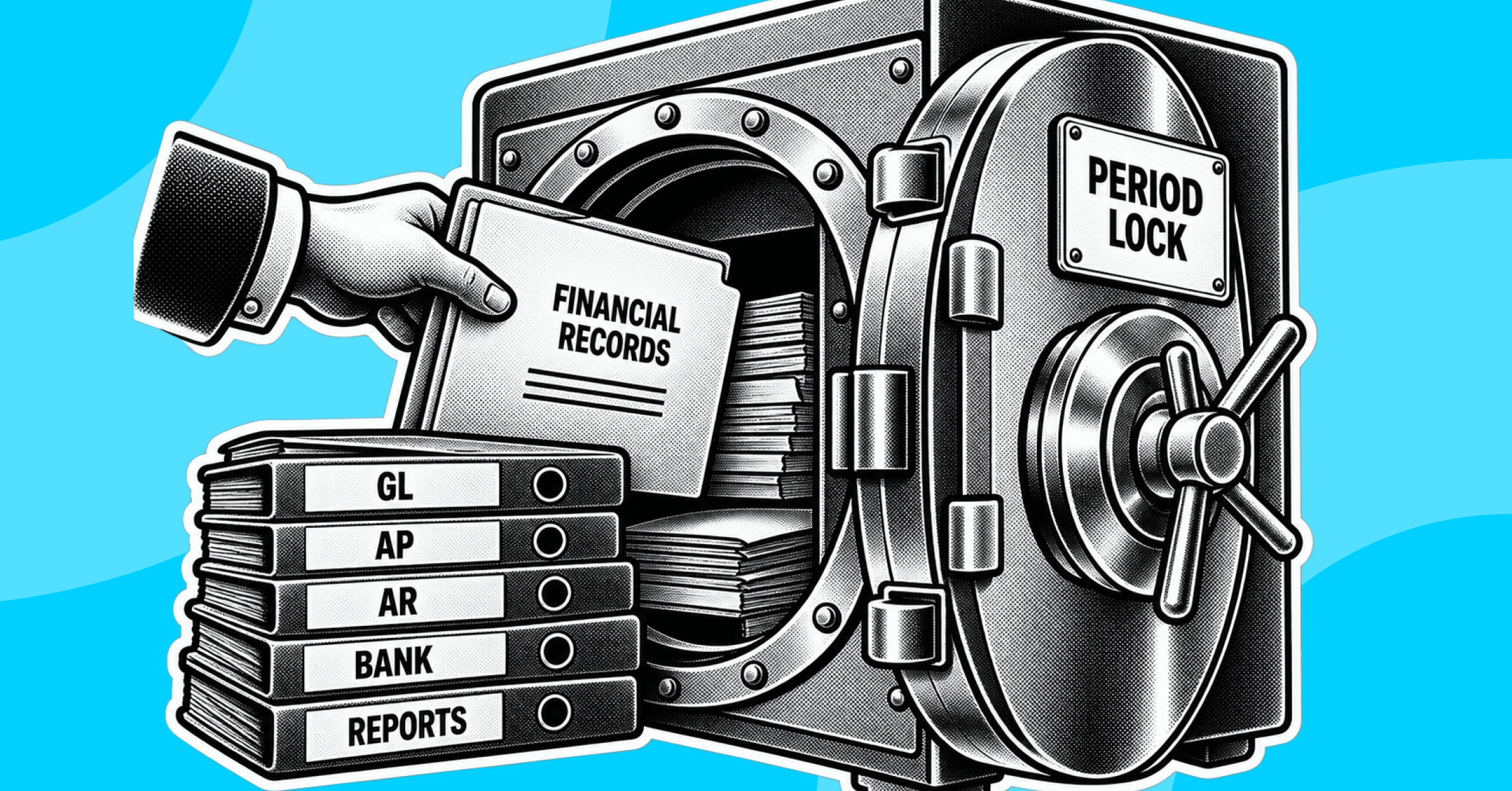
- 5. Lock the Period: Finalize and lock the accounting period in your ERP or accounting software to prevent unauthorized changes after reporting is complete.
Why Month-End Reporting Matters
- Financial health monitoring: Monthly statements are the earliest, most reliable signal of whether the business is on plan, ahead, or falling behind.
- Identifying improvement areas: Variance analysis surfaces cost overruns, margin compression, or collection slippage while there's still time to act.
- Regulatory and audit compliance: Clean, timely close cycles keep the books audit-ready year-round instead of creating a scramble at year-end.
- Benchmarking: Month-over-month and year-over-year comparisons only work if every close is complete and consistent.
- Forecasting accuracy: FP&A models are only as good as the actuals feeding them; a rushed close produces a rushed forecast.
- Stakeholder confidence: Boards, lenders, and investors read a slow or error-prone close as a signal of weak financial controls.
Common Challenges in Month-End Reporting
- Time constraints: Most teams are compressing five stages of work into a handful of business days, often while still handling day-to-day accounting.
- Data collection complexity: Transaction data is scattered across the ERP, bank portals, subledgers, and spreadsheets, with no single source of truth.
- Manual task inefficiency: Spreadsheet-based matching and manual journal entries are slow and error-prone, especially at volume, and are a documented driver of financial misstatement risk according to the Journal of Accountancy's guidance on internal controls.
- Disconnected systems: When the ERP, billing system, and bank feeds don't talk to each other, someone has to reconcile the gaps by hand every month.
- Reconciliation volume at scale: Enterprises and shared services teams managing multiple entities, currencies, or business units see reconciliation effort multiply, not just add up, as complexity grows.
Month-End Reporting vs. Month-End Close vs. Year-End Close
These three terms get used interchangeably, but they describe different things:
- Month-end reporting refers specifically to the financial statements and analysis produced at the end of the month, the output of the close.
- Month-end close is the full process, data collection, reconciliation, adjustments, review, and reporting, that produces those statements and locks the period. For a deeper walkthrough of that process on its own, see our guide to the month-end close process.
- Year-end close covers the same activities at a larger scale, plus additional steps: tax provisioning, statutory adjustments, external audit support, and final adjusting entries that only happen once a year.
The practical implication: a company that runs a disciplined month-end close all year, ideally moving toward a continuous close model for its highest-volume accounts, has most of the work for year-end close already done. Teams that only reconcile properly in December are effectively doing twelve months of clean-up in one close cycle.
The Month-End Reporting Checklist
A checklist doesn't replace good accounting judgment, but it does make the process repeatable and easier to hand off, review, or scale across entities. Here's a practical checklist split into three phases.
Before Month-End
☐ Review budget-to-actual performance so far in the period
☐ Communicate close deadlines and responsibilities to the team
☐ Gather supporting documentation: invoices, contracts, bank statements
☐ Begin preliminary account reconciliations for accounts with low activity
☐ Flag and start resolving any known discrepancies or open items
During Month-End
☐ Record all outstanding transactions and revenue/expense entries
☐ Reconcile bank and credit card accounts against the general ledger, using a structured bank reconciliation template if you don't already have one
☐ Verify subledger balances (AR, AP, inventory) tie to control accounts
☐ Post accruals, deferrals, and depreciation entries
☐ Review fixed assets for additions, disposals, or amortization adjustments
☐ Complete final reconciliations and close subledgers
☐ Generate and review financial statements before finalizing
After Month-End
☐ Distribute reports to leadership and relevant stakeholders
☐ Archive supporting documentation and reconciliation records for audit trail
☐ Analyze trends and variances against budget and prior periods using a variance analysis template
☐ Update close procedures based on what slowed the team down this cycle
☐ Set up templates and reminders for the next close cycle
Best Practices to Speed Up Month-End Reporting
- Standardize the close calendar: A documented, repeatable schedule with fixed deadlines removes the guesswork every month.
- Start what you can before month-end: Reconciling low-activity accounts and gathering documentation early shortens the critical path once the period closes.
- Assign clear ownership: Every reconciliation, adjustment, and report should have one accountable owner, not a shared responsibility that nobody drives.
- Build in a review layer: Independent review of reconciliations and statements before they're finalized is a core internal control principle under frameworks like COSO, not an optional extra step, and it catches errors before they reach leadership.
- Automate repetitive reconciliation and reporting work: Manual matching and manual variance write-ups are the two tasks most consistently cited as the biggest time drains in month-end close, and the two most addressed by reconciliation automation.
- Review and improve after every cycle: A short retro on what slowed the close down is how teams actually shorten it over time, rather than repeating the same bottlenecks every month.
How Bluecopa Simplifies Month-End Reporting
Bluecopa is an AI-native finance operations platform that automates the reconciliation and reporting work that typically consumes the most time in month-end close. Samyx Recon handles multi-field, fuzzy and deterministic matching across ledgers, bank feeds, and subledgers, cutting the manual matching effort that drags out reconciliation. Samyx Narrate generates variance analysis and trend insights automatically, so teams spend less time building commentary by hand and more time reviewing it.
- Automated reconciliation across the general ledger, subledgers, and bank feeds, instead of spreadsheet-based matching.
- Standardized close workflows so every entity and every month follows the same repeatable process.
- AI-generated variance analysis and reporting, reducing the manual work of building management reports from scratch.
- A single data layer across Order-to-Cash, Procure-to-Pay, and Record-to-Report, so close data doesn't have to be reconciled across disconnected point solutions.
Yatra used Bluecopa to close 90% faster and generate reports 200x faster than their prior manual process, while cutting manual reconciliation effort by 80%. If your team is still closing the books through spreadsheets and email chains, a personalized demo will show you exactly where that time is going and how much of it can be automated.
FAQ
1. What is month-end reporting used for?
Month-end reporting gives leadership, finance teams, and stakeholders an accurate, timely view of financial performance and position, supporting decisions on spending, forecasting, and strategy between quarterly or annual reviews.
2. What's the difference between month-end reporting and month-end close?
Month-end close is the full process of collecting, reconciling, and adjusting financial data. Month-end reporting is the output of that process, the actual financial statements and analysis produced once the close is complete.
3. What reports are included in month-end reporting?
The core outputs are the income statement, balance sheet, cash flow statement, and variance report comparing actuals to budget or prior periods.
4. How long should month-end close take?
Timelines vary by company size and complexity, but most finance teams aim to complete close and reporting within the first five to ten business days of the following month. Teams with more manual processes or multiple entities often take longer.
5. How can finance teams speed up month-end reporting?
The biggest gains come from standardizing the close calendar, starting reconciliations before month-end where possible, assigning clear ownership, and automating manual reconciliation and variance analysis work.
6. Is a month-end reporting checklist necessary?
Yes. A checklist makes the process repeatable across accountants and entities, reduces the risk of missed steps, and makes it easier to onboard new team members into the close process.