

Comparing the top 8 best AI reconciliation software options for finance teams in 2026 includes 1. BlackLine, 2. HighRadius, 3. FloQast, 4. Trintech (Cadency & Adra), 5. Bluecopa, 6. Numeric, 7. SolveXia, and 8. Kognitos.
If your close still runs on spreadsheets and tribal knowledge, every month-end brings the same fire drill: unmatched transactions, a controller chasing exceptions late at night, and an audit trail nobody can fully reconstruct. AI reconciliation software fixes this by matching bank, subledger, and intercompany transactions automatically and routing only genuine exceptions to a human.
This article compares the 8 AI reconciliation platforms finance teams evaluate most often in 2026, ranked on official product capabilities, verified G2 and Capterra feedback, and real company-size fit, not marketing claims. Getting this choice wrong is expensive twice over: once in the implementation effort spent configuring a tool that doesn't match your ERP or entity structure, and again every month-end the reconciliation process still doesn't scale with transaction volume.
Who Needs AI Reconciliation Software
Not every finance team needs the same kind of AI-powered reconciliation software. The right fit depends on transaction volume, entity structure, and how much of the process is already automated in your ERP.
What Is AI Reconciliation Software?
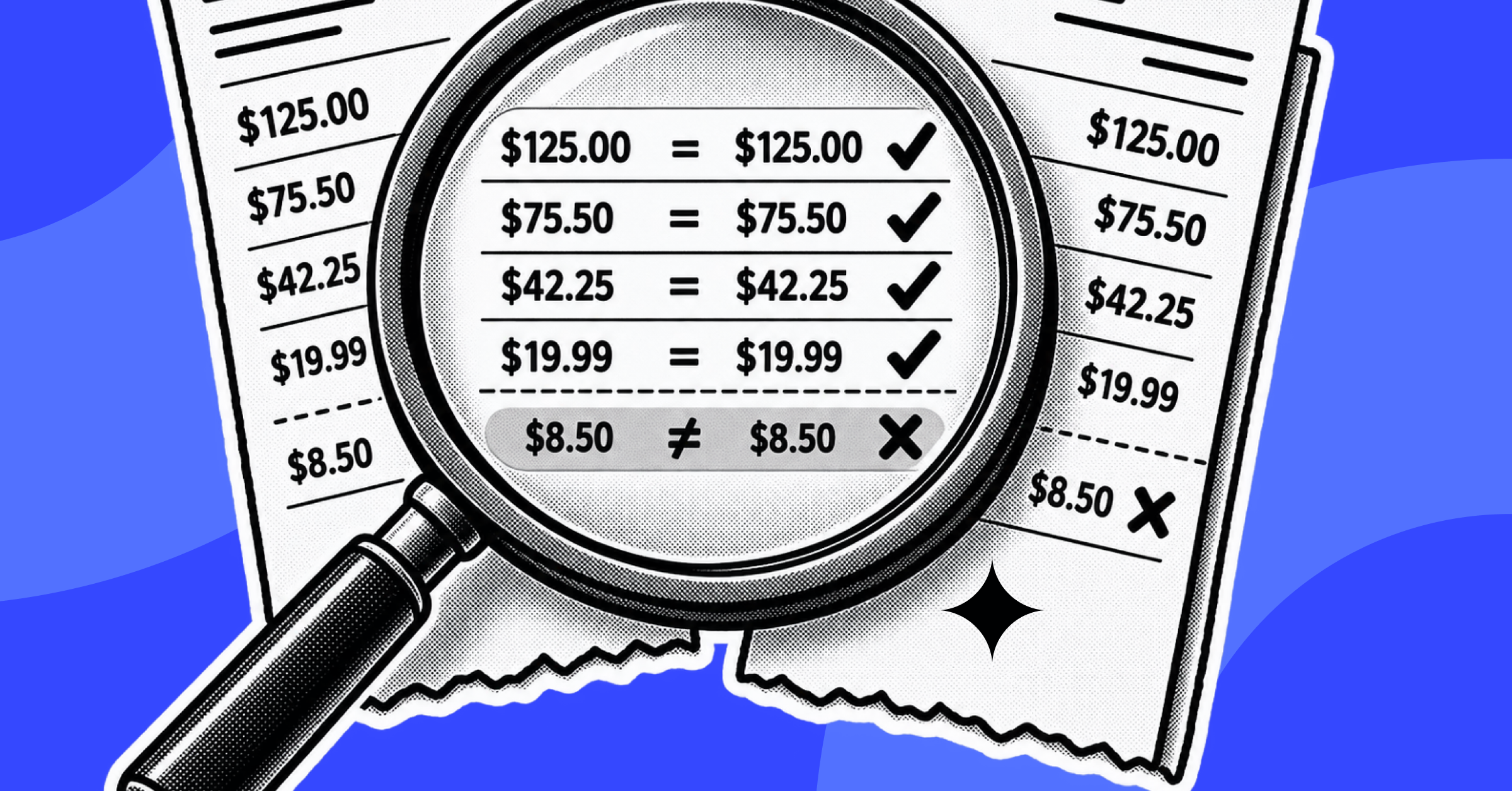
AI reconciliation software automatically matches transactions across bank statements, subledgers, ERPs, and intercompany accounts, and flags only the exceptions a human needs to review. It typically covers bank reconciliation, subledger reconciliation, intercompany reconciliation, and three-way matching for procurement.
Per Gartner's prediction that 90% of finance functions will deploy at least one AI-enabled technology by 2026, reconciliation is one of the first processes finance teams automate because the matching logic is well defined and the manual cost is high.
How We Ranked the 8 Best AI Reconciliation Software Solutions
We spent 30+ hours researching this category: official product documentation, verified G2 and Capterra reviews, and published outcome metrics for every vendor on this list.
We weighted the following factors:
- AI maturity and matching intelligence — whether matching is rule-based, machine-learning-assisted, or genuinely agentic
- ERP integration breadth — native connectors to SAP S/4HANA, Oracle NetSuite, Sage Intacct, Microsoft Dynamics 365, QuickBooks, Xero, and Zoho Books
- Verified user sentiment — combined G2 and Capterra feedback specific to reconciliation and matching, not the whole product suite
- Company-size fit — whether the platform's own positioning and pricing model match the buyer segment it claims to serve
A high star rating on a thin review base is weighted differently than a long-standing G2 leader with hundreds of reviews, which is why a newer entrant with the highest rating on this list is not automatically ranked first.
Side-by-Side Comparison: Best AI Reconciliation Tools at a Glance
8 Best AI Tools for Reconciliation Reviewed in Detail
1. BlackLine
Best For: Enterprise finance teams and accounting operations departments that need to modernize reconciliation from manual, reactive workflows into an automated, audit-ready process.
Overview: BlackLine is an AI-powered account reconciliation platform built around Verity AI, an agent that executes end-to-end reconciliation prep, transforms raw data into analysis-ready context, and maintains a full audit trail. It supports high-frequency reconciliations across bank, subledger, and intercompany accounts. Kempinski Hotels reported a 50% reduction in time spent on reconciliations after adopting BlackLine.
Key Features:
- Verity Prepare: AI agent that automates end-to-end reconciliation prep while preserving audit trails.
- Automated Transaction Matching: Groups transactions within defined timeframes with exception handling and anomaly detection.
- High-Frequency Reconciliations: Supports daily reconciliation cadence for risk-sensitive accounts.
- ERP Integration: Connects into existing enterprise systems for workflow continuity.
- Audit and Compliance Support: Built-in governance, security, and auditability for SOX and GAAP requirements.
Pros:
- Strong transaction matching on high volume: "The transaction matching has been a tremendous benefit in our cash reconciliation process."
- High auto-match rate achievable: "We have achieved an outstanding milestone: over 70% auto reconciliation."
Source: G2
Cons:
- Matching setup has a learning curve: "Some of the matching setup is kind of tricky."
- Integration friction during onboarding: "Integration issues complicated the onboarding process."
Source: G2
Pricing: BlackLine doesn't publish pricing. According to Coefficient, contracts average approximately $77,000/year, ranging from $17,500 to $340,000/year depending on modules, entity count, and user seats.
2. HighRadius
Best For: Enterprise and mid-market finance teams across manufacturing, software, retail, and healthcare that need AI-driven reconciliation tied into a broader Order-to-Cash suite.
Overview: HighRadius is an AI-powered account reconciliation platform built for faster financial close, with specialized agents for bank, intercompany, POS, and cash accounting reconciliation, used by 1,500+ companies. Its R2R Agent Builder lets finance teams configure agentic AI workflows for reconciliation and journal automation without custom development.
Key Features:
- Transaction Auto-Match: AI-driven exception handling layered on top of automated matching.
- Journal Automation: Automated journal posting to reduce manual entry.
- GL Reconciliation: Automates subledger-to-GL matching with real-time discrepancy detection.
- Intercompany Matching: Syncs AR/AP across entities and automates adjusting journals.
- Prepaid Substantiation: Automated amortization schedules with audit-ready controls.
Pros:
- Automates journal entry posting: "It matches transactions and automates the Journal Entries needed to post in ERP."
- Matching rules support process consistency: "Matching Rules which helps the team from a process perspective; user friendly and easy to learn."
Source: G2
Cons:
- ERP compatibility gaps: "Not working well with Business Central ERP."
- No partial matching: "Not being able to partial match to identify what is missing."
Source: G2
Pricing: Not published on the official site or on G2. HighRadius uses a custom enterprise pricing model negotiated directly with the vendor. Custom pricing - contact sales.
3. FloQast
Best For: CFOs, controllers, and accounting teams at fast-growing mid-market companies that want reconciliation built directly into their close checklist rather than as a standalone tool.
Overview: FloQast is used by 3,500+ companies to automate end-to-end reconciliation across global entities, tying preparer and reviewer assignments, due dates, and review notes directly to the close checklist. Its AI-powered transaction matching handles thousands of transactions at once. Customers include Lululemon, DoorDash, and Zoom.
Key Features:
- Reconciliation Management: Assign preparers and reviewers, set due dates, and track review notes with full audit reports.
- Advanced Automation: AI-powered transaction matching across thousands of line items at once.
- Amortization and Depreciation Automation: Automates recurring schedule-based reconciliations.
- Ecosystem Integrations: Direct ERP integration plus connections to Box, Dropbox, Google Drive, SharePoint, Slack, and Microsoft Teams.
Pros:
- Cuts manual GL data entry: "FloQast automates the tie-out process by pulling General Ledger balances directly from your ERP system, which significantly reduces manual data entry."
- Handles large data sets well: "The reconciliation feature, along with the automatic reconciliation, is particularly useful for large data sets."
Source: G2
Cons:
- Bulk editing runs slowly: "Bulk editing reconciliations runs sluggishly. It lacks native connection to our internal file server."
- Less granular than enterprise-grade tools: "It may lack the granular transaction-level detail and advanced functionality of some other enterprise-grade reconciliation platforms."
Source: G2
Pricing: FloQast doesn't publish pricing. According to G2, FloQast starts around $12,000/year, with mid-market contracts (50-200 employees) typically ranging from $30,000 to $60,000/year.
4. Trintech (Cadency & Adra)
Best For: Large, global enterprises with complex multi-entity structures (Cadency) and mid-market finance teams that need a simpler reconciliation and close product (Adra).
Overview: Trintech's Cadency platform is built for large enterprises managing multiple entities and acquisitions, with balance sheet reconciliation, transaction matching, and governance, risk, and compliance automation in one platform. Boston Scientific auto-reconciles 4,400+ accounts across 93 entities and 53 countries on Cadency, and H&R Block processes over 1 million transactions monthly at peak season. Adra is Trintech's mid-market product line covering similar functionality at a smaller scale.
Key Features:
- Balance Sheet Reconciliations: Automated error remediation across account types.
- Transaction Matching: Auto-matching engine for high-volume transaction sets.
- Close Management: Dashboard-driven workflows for close task tracking.
- GRC Automation: Governance, risk, and compliance controls built into the workflow.
- Intercompany Accounting: Automates intercompany transaction workflows.
Pros:
- Automates month-end reconciliation and matching: "Streamlines and automates our month-end close processes, including account reconciliations, transaction matching."
Source: G2
Cons:
- Reported reconciliation slowdowns: "Reconciliation issues and slow performance affect day-to-day efficiency during high-volume periods."
Source: G2
Pricing: Not published on the official site, G2, or Capterra. Custom pricing — contact sales.
5. Bluecopa
Best For: Mid-market to enterprise finance teams and Global Capability Centers, particularly in BFSI, ecommerce, logistics, manufacturing, and SaaS across India, SEA, the Middle East, and Africa, that need reconciliation unified with the rest of their O2C, P2P, and R2R operations rather than as an isolated tool.
Overview: Bluecopa is an AI-native finance operations platform built on SamyxAI, the only shortlisted platform here that unifies Order-to-Cash, Procure-to-Pay, and Record-to-Report reconciliation on a single data layer instead of separate modules. Its matching engine, Samyx Recon, processes 5M+ records per hour at 97-99% accuracy. Yatra achieved 7x faster AR reconciliation and an 80% reduction in manual reconciliation work after adopting Bluecopa, and HackerEarth cut reconciliation errors by 60%.
Key Features:
- Samyx Recon: Multi-field fuzzy and deterministic hybrid matching across bank, subledger, and intercompany data at 5M+ records/hour.
- Samyx Extract: PDF and spreadsheet data extraction with page-level and line-level provenance.
- Samyx Build: Policy-as-code gates for approvals, thresholds, and segregation of duties.
- Samyx Narrate: AI-powered variance analysis and trend insight generation.
- Unified O2C, P2P, R2R: Reconciliation automation connected to cash application, invoice matching, and continuous close on one data layer.
- 200+ Integrations: SAP, Oracle NetSuite, Sage Intacct, Zoho Books, QuickBooks, Xero, Stripe, Shopify, Salesforce, and major BI tools.
Note on review data: Bluecopa has 26 G2 reviews as of July 2026. This is a smaller sample than long-standing category leaders, so buyers should weigh it alongside vendor references and a live demo rather than rating alone.
Pros:
- Handles complex finance operations end to end: "Bluecopa provides me with a ready solution that can ease multiple tasks and complex day to day finance operations."
- Fast, high-volume processing: "Extremely easy to use. Processes large volumes of data fast."
Source: G2
Cons:
Bluecopa has a growing review base with no reported negatives around its reconciliation or matching functionality to date, though the smaller sample size means broader market feedback is still emerging. Reviewers have flagged adjacent, non-reconciliation areas for improvement, including dashboard depth for very large multi-location enterprises and a learning curve during initial rollout.
Pricing: Not published. Bluecopa uses a custom pricing model based on transaction volume, entity count, and modules deployed. Custom pricing - contact sales.
6. Numeric
Best For: High-growth public and private companies on NetSuite, Xero, or QuickBooks Online that need reconciliation tied to live, transaction-line-level ERP data.
Overview: Numeric is built for complex accounting teams managing high-volume reconciliations who want to close faster with confidence. It syncs real-time, transaction-line-level detail directly from the ERP and flags accounts when new transactions disrupt an already-reconciled balance. Brex reduced close time from 6 to 4 days using Numeric, and Public.com shaved 2 days off its month-end close.
Key Features:
- Real-Time ERP Integration: Transaction-line detail synced from NetSuite, Xero, QuickBooks Online, and Sage Intacct.
- Cloud Storage Connections: Direct links to Google Drive, SharePoint, and Box for workpaper management.
- Auto-Submission: Automatically submits predictable, consistently balanced accounts.
- Proactive Alerts: Flags reconciled accounts when new transactions disrupt the balance.
Pros:
- Intuitive reconciliation workflow: "The reconciliation functionality is intuitive and well-structured."
- Automated rollover reduces manual work: "Reconciliations are able to roll over without any manual intervention."
Source: G2
Cons:
- Sign-off is not selective: "Forces us to sign off on every assigned flux line, whether required."
- Limited off-cycle reconciliation dates: "Reconcile to a date other than just the end of the month."
Source: G2
Pricing: According to Numeric, the Essentials plan starts at $30 per user per month; Growth and Enterprise tiers are custom-priced based on ERP complexity and automation scope.
7. SolveXia
Best For: Mid-to-enterprise finance teams in financial services, retail, travel, and healthcare that want a no-code platform to build their own reconciliation workflows without heavy IT involvement.
Overview: SolveXia is a no-code, AI-powered reconciliation platform that uses fuzzy logic and configurable matching rules to reconcile bank, payment, GL, AP/AR, intercompany, and balance sheet accounts of any size. Customers include 7-Eleven and Marriott, and SolveXia reports reconciling 500,000 transactions daily across its customer base.
Key Features:
- AI-Powered Fuzzy Matching: Configurable matching rules beyond exact-match logic.
- Unified Data Connections: Pulls data from multiple source systems into one reconciliation workflow.
- Real-Time Dashboards: Exception flagging and status visibility.
- No-Code Process Designer: Business users build and modify reconciliation logic without developer support.
Pros:
- Reduces supplier payment mapping errors: "SolveXia takes time and potential errors out of mapping payments from suppliers accurately."
- Reliable at scale: "Flexibility, stability and performance is top notch."
Source: G2
Cons:
- Process Designer requires Excel skills: "Process Designer needs Excel skills to develop processes for reconciliation workflows."
- Strict naming conventions: "Naming conventions require specific formatting; forgotten suffixes cause report rejections."
Source: G2
Pricing: Not published on the official site. According to Capterra lists SolveXia's starting price as "Contact vendor," with no free trial available. Custom pricing - contact sales.
8. Kognitos
Best For: Enterprise finance and operations teams in banking, manufacturing, and supply chain that need agentic automation for exception-heavy processes, including reconciliation and three-way matching, described in plain English rather than technical rules.
Overview: Kognitos is a deterministic, agentic AI automation platform where processes are described in plain English and compiled into executable, auditable workflows. Its Resolution Agent handles exceptions with context-aware guidance and its Knowledge Manager captures resolution patterns to improve automation over time. Kognitos reports a Fortune 50 food and beverage company saved over $1M annually and 92,000 hours through a single automated process.
Key Features:
- Builder Studio: Converts plain-English process descriptions into executable, auditable workflows.
- Agent Manager: Deterministic execution with complete audit trails.
- Resolution Agent: Context-aware exception handling for reconciliation and matching mismatches.
- Knowledge Manager: Captures resolution patterns to reduce repeat exceptions over time.
- Deep Integrations: 130+ pre-built connectors including SAP, Oracle, and Workday.
Note on review data: Kognitos has no publicly indexed G2, Capterra, or Gartner Peer Insights reviews as of August 2026. The outcome figures above come from Kognitos-published case studies, not third-party review platforms, and should be verified with direct customer references before purchase.
Pros:
Kognitos-published case study, not a third-party review: Century Supply Chain Solutions automated 50,000+ carrier bookings and bills of lading per month, saving an estimated 50,000 employee hours.
Cons:
The absence of independent G2, Capterra, or Gartner Peer Insights reviews is itself the primary caution here. Buyers cannot currently cross-check Kognitos's reconciliation-specific claims against verified third-party user feedback the way they can for every other vendor on this list.
Pricing: Not published. Capterra lists Kognitos's starting price as "Contact vendor," with no free trial available. Custom pricing - contact sales.
How to Choose the Right AI Reconciliation Software
Work through these questions before shortlisting a vendor:
- What's your ERP environment? SAP S/4HANA, Oracle NetSuite, or Sage Intacct shops need native connectors, not custom middleware, or implementation drags on for months.
- What's your primary bottleneck? Bank reconciliation volume, intercompany matching across entities, or three-way matching in procurement each favor a different vendor.
- What's your buyer ICP? A global enterprise with 50+ entities has different needs than a single-entity mid-market SaaS company closing its books solo.
- What's your deployment timeline? No-code platforms like SolveXia and agentic tools like Kognitos typically move faster than large enterprise suites requiring extended configuration.
- Do you need a standalone tool or a unified platform? If reconciliation, cash application, and invoice matching all live in different systems today, a unified O2C, P2P, and R2R platform removes the handoffs between them.
By stakeholder:
- CFO: Cares about close-cycle impact and time to ROI.
- Controller / Head of Accounting: Cares about match accuracy, exception workflow, and audit trail depth.
- Finance Operations / Shared Services: Cares about transaction volume ceilings and multi-entity scalability.
- IT / ERP Team: Cares about integration effort, security posture, and deployment model.
- Internal Audit: Cares about compliance coverage, evidence management, and access controls.
Practitioner discussions in communities like r/Accounting and r/CFO show a consistent pattern: complaints center less on whether a tool can match transactions and more on what happens when it can't — brittle exception queues, rules that break the moment a new vendor format shows up, and reconciliation data that lives apart from the rest of the close. Bluecopa's Samyx Recon is built to keep exception handling and audit trail generation inside the same AI-native layer as the rest of O2C, P2P, and R2R, rather than as a bolt-on module.
Common Mistakes When Choosing AI Reconciliation Tools
- Confusing reconciliation software with close management software. Reconciliation matches transactions; close management orchestrates the entire month-end checklist. Some vendors, like FloQast, blend both; others are reconciliation-only.
- Treating "AI-powered" as meaningful without asking what the AI does. Rule-based matching with a marketing label is not the same as a self-learning matching engine. Ask for the actual auto-match rate and how exceptions are routed.
- Choosing based on overall G2 rating without filtering by company size. A 4.8/5 rating built on 26 reviews tells a different story than the same rating built on hundreds of reviews. Filter by company size before comparing scores.
- Ignoring how reconciliation output connects to close and reporting. A reconciliation tool that doesn't feed cleanly into your close checklist or management reporting just moves the manual work downstream.
- Underestimating the difference between rule-based and self-learning matching. AI-based reconciliation platforms that learn from exception resolution reduce the maintenance burden of constant reconfiguration.
- Evaluating reconciliation in isolation from O2C and P2P. If your reconciliation data comes from cash application and vendor invoice matching, buying a standalone recon tool on top of separate O2C and P2P systems just adds another handoff.
Why Bluecopa Is the Right AI Reconciliation Software for Unified Finance Operations
Bluecopa is the only platform on this list that unifies Order-to-Cash, Procure-to-Pay, and Record-to-Report reconciliation on a single AI-native data layer through SamyxAI. Every other enterprise vendor here, including HighRadius, treats reconciliation as one module among several separately licensed products. For a mid-market or enterprise finance team, especially a shared services center or GCC running O2C, P2P, and R2R across multiple entities, that means one data model instead of three systems that all need separate reconciliation logic and separate audit trails.
- Matching depth: Samyx Recon processes 5M+ records per hour at 97-99% accuracy across bank, subledger, and intercompany reconciliation.
- Unified data layer: Reconciliation output feeds directly into continuous close and management reporting instead of a separate export step.
- Built for the target ICP: Positioned for mid-market to enterprise finance teams and GCCs across BFSI, ecommerce, logistics, manufacturing, and SaaS in India, SEA, the Middle East, and Africa, not SMB.
- Governance built in: Samyx Build's policy-as-code controls handle approval thresholds and segregation of duties without a separate GRC add-on.
- 200+ integrations: Native connectors to SAP, Oracle NetSuite, Sage Intacct, Zoho Books, QuickBooks, Xero, and major BI platforms mean reconciliation doesn't require custom middleware.
Bluecopa does not cover treasury management, FP&A planning, or statutory consolidation, so a finance team that needs those specific capabilities in the same platform should treat this as one factor in a broader stack decision, not a reason to rule it out for reconciliation itself.
Bottom Line
If you're an enterprise finance team with heavy SOX obligations and need the deepest reconciliation prep automation, BlackLine is the strongest match. Teams built around a broader Order-to-Cash motion at high transaction volume should look at HighRadius instead, particularly if cash application and reconciliation need to work together tightly. Fast-growing mid-market companies that want reconciliation built into their existing close checklist are best served by FloQast, while large global enterprises managing dozens of entities and acquisitions should evaluate Trintech's Cadency, or Adra if the requirements are closer to mid-market.
If your reconciliation data is fragmented across O2C, P2P, and R2R systems and you're a mid-market to enterprise team or GCC in India, SEA, the Middle East, or Africa, Bluecopa is built specifically for that unification. Numeric is the better fit if you're already deep on NetSuite, Xero, or QuickBooks Online and want reconciliation tied to live ERP data with transparent published pricing. Finance ops teams that want to build and adjust their own matching logic without developer support should look at SolveXia, and enterprises with exception-heavy, plain-English-describable processes, but comfortable operating without third-party review validation yet, can evaluate Kognitos.
FAQ
1. What is AI reconciliation software?
AI reconciliation software automatically matches transactions across bank statements, subledgers, and intercompany accounts using AI-based matching engines, then flags only genuine exceptions for review.
2. How does AI reconciliation software reduce DSO?
By matching cash application and AR data automatically, AI reconciliation software clears outstanding receivables faster, which directly shortens Days Sales Outstanding (DSO).
3. What's the difference between reconciliation software and close management software?
Reconciliation software matches transactions; close management software like FloQast orchestrates the entire month-end checklist, including but not limited to reconciliation.
4. How much does AI reconciliation software cost?
Most enterprise vendors like BlackLine, HighRadius, and Trintech use custom pricing; Numeric publishes plans starting at $30 per user per month.
5. Which AI reconciliation software has the highest G2 rating?
Bluecopa and Numeric both hold 4.8/5 on G2 as of August 2026, though on materially smaller review volumes than long-standing leaders like BlackLine.
6. Can AI reconciliation software work with SAP S/4HANA?
Yes. BlackLine, HighRadius, Trintech, and Bluecopa all publish native SAP S/4HANA integrations for reconciliation and journal automation.
7. Is AI reconciliation software the same as bank reconciliation software?
No. Bank reconciliation is one sub-process; AI reconciliation software also covers subledger, intercompany, and three-way matching for procurement.
8. What's the best AI reconciliation software for a GCC or shared services team?
Bluecopa is built specifically for GCC and shared services finance teams that need O2C, P2P, and R2R reconciliation unified on one AI-native platform.
9. Does agentic reconciliation software actually reduce manual exception handling?
Yes, when the agent learns from past exception resolutions, as seen in HighRadius's R2R Agent Builder and Kognitos's Resolution Agent, though Kognitos lacks third-party review validation of this claim.
Editorial Note
Last Reviewed: August 2026
Vendor capabilities, pricing, and customer ratings change over time. Confirm current features, pricing, and integrations directly with the vendor before making a decision.
All Vendors Reviewed
We evaluated the following AI reconciliation and account reconciliation tools before narrowing this list to the 8 featured above: BlackLine, HighRadius, FloQast, Trintech (Cadency/Adra), Bluecopa, Numeric, SolveXia, Kognitos, OneStream, ReconArt, ChatFin, Duco, Xceptor, AutoRek, Gresham (Control Now/Clareti), Workiva, Cashbook, MindBridge, SymphonyAI Sensa (Ayasdi), Sage Intacct, Oracle NetSuite, QuickBooks Online, Xero (JAX), Zoho Books, Prophix One, Vena Solutions, Datarails, Trullion, Engini.ai, Optimus.tech, Zapliance, Nanonets, Booke.ai, Vic.ai, Certinia, Zuora, and Spendflo/Zip/Airbase/Rippling Finance.